全局首页及应用首页配置方法(homepage)

1 Oinone平台首页介绍

1.1 首页包括全局首页应用首页两类

  • 全局首页:指用户在登录时未指定重定向地址的情况下使用的应用首页
  • 应用首页:指用户在切换应用时使用的首页

PS:全局首页本质上也是应用首页,是在用户没有指定应用时使用的首页。如登录后。

1.2 全局首页查找规则

  1. 找到当前用户有权限访问的全部应用。
  2. 若使用AppConfig配置首页,则优先使用该配置作为全局首页。若未指定或无权限访问,则继续第3步。
  3. 依次按照应用优先级,获取有权限的首页或菜单作为全局首页。
  4. 若未查找到任何可访问页面,则提示无权限访问相关异常,用户无法进入平台。

1.3 应用首页查找规则

  1. 在指定应用下,获取有权限的首页或菜单作为应用首页。
  2. 若未查找到任何可访问页面,则提示无权限访问相关异常,用户进入应用后无法正常查看或操作。

2 配置全局首页

2.1 使用应用优先级设置全局首页

/**
 * 演示模块
 *
 * @author Adamancy Zhang at 16:55 on 2024-03-24
 */
@UxHomepage(@UxRoute(DemoDepartment.MODEL_MODEL))
@Component
@Boot
@Module(
        name = DemoModule.MODULE_NAME,
        displayName = "演示应用",
        version = "1.0.0",
        dependencies = {ModuleConstants.MODULE_BASE},
        priority = 0
)
@Module.module(DemoModule.MODULE_MODULE)
@Module.Advanced(selfBuilt = true)
public class DemoModule implements PamirsModule {

    public final static String MODULE_MODULE = "demo";

    public final static String MODULE_NAME = "demo";

    @Override
    public String[] packagePrefix() {
        return new String[]{"pro.shushi.pamirs.demo"};
    }

}

注意事项

  • @UxHomepage用于指定应用首页
  • @Module#priority用于指定模块优先级,按升序排列

PS:下面描述的内容不再提供完整的模块定义内容,仅针对@UxHomepage进行介绍。

3 配置应用首页

3.1 使用@UxHomepage配置应用首页

指定模型的默认表格视图作为应用首页

@UxHomepage(@UxRoute(DemoDepartment.MODEL_MODEL))

该指定方式将产生以下结果:

  • 生成一个跳转动作(ViewAction),其模型编码为DemoDepartment.MODEL_MODEL,动作名称为homepage
  • 设置ModuleDefinition#homePageModel和ModuleDefinition#homePageName为该跳转动作。

指定模型对应的菜单作为应用首页

在当前应用下有如下菜单定义:

/**
 * 演示模块菜单
 *
 * @author Adamancy Zhang at 17:16 on 2024-03-24
 */
@UxMenus
public class DemoMenus {

    @UxMenu("演示部门")
    @UxRoute(DemoDepartment.MODEL_MODEL)
    class DepartmentManagement {
    }

    @UxMenu("演示员工")
    @UxRoute(DemoEmployee.MODEL_MODEL)
    class EmployeeManagement {
    }
}

根据菜单定义我们可以知道:

演示部门这个菜单会生成一个跳转动作(ViewAction),其模型编码为DemoDepartment.MODEL_MODEL,动作名称为DemoMenus_DepartmentManagement

因此,我们可以使用如下方式指定应用首页为演示部门这个菜单:

@UxHomepage(actionName = "DemoMenus_DepartmentManagement", value = @UxRoute(DemoDepartment.MODEL_MODEL))

4 在应用中心修改应用首页

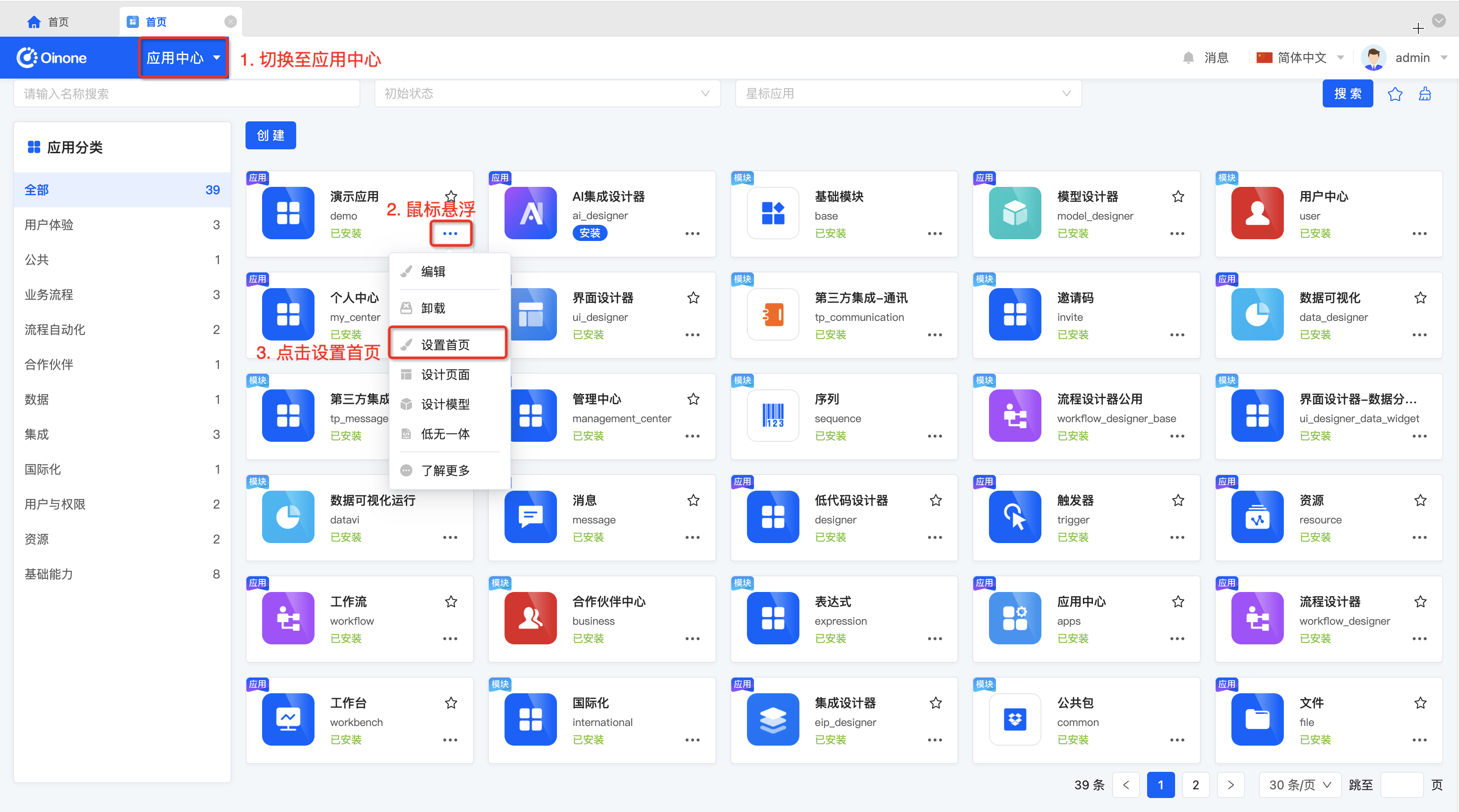
在平台启动之后,将无法通过代码的方式修改首页,因此需要在应用中心修改应用首页。

按照如下图所示操作对应用首页进行设置。
设置首页1

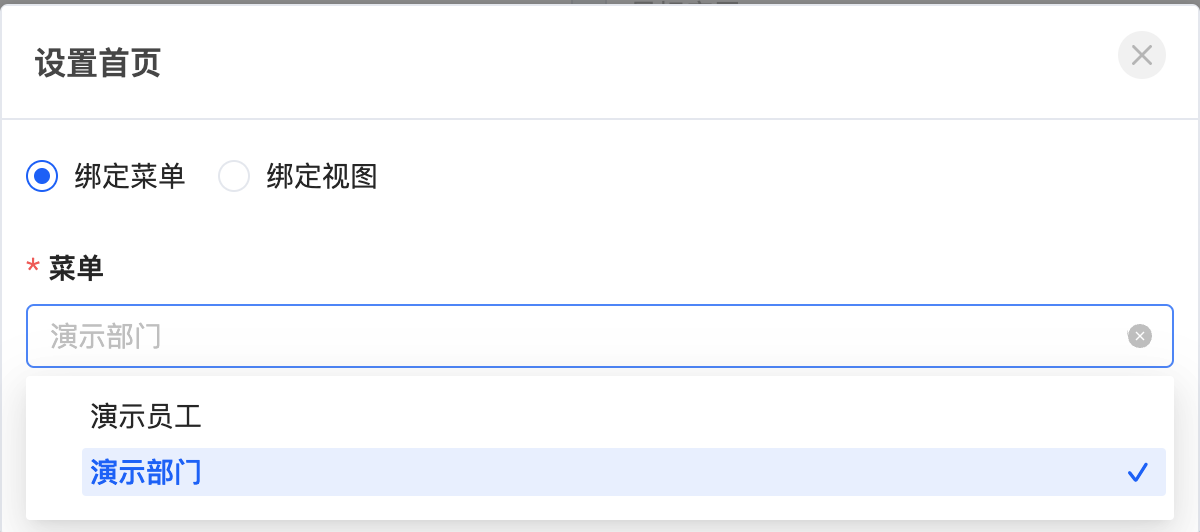
在绑定菜单选项中,选择指定菜单即可。

设置首页2

本文来自投稿,不代表Oinone社区立场,如若转载,请注明出处:https://doc.oinone.top/backend/6394.html

(0)
张博昊的头像张博昊数式管理员
上一篇 2024年3月24日 pm1:43
下一篇 2024年3月27日 pm2:41

相关推荐

  • Oinone请求路由源码分析

    通过源码分析,从页面发起请求,如果通过graphQL传输到具体action的链路,并且在这之间做了哪些隐式处理分析源码版本5.1.x 请求流程大致如下: 拦截所有指定的请求 组装成graphQL请求信息 调用graphQL执行 通过hook拦截先执行 RsqlDecodeHook:rsql解密 UserHook: 获取用户信息, 通过cookies获取用户ID,再查表获取用户信息,放到本地Local线程里 RoleHook: 角色Hook FunctionPermissionHook: 函数权限Hook ,跳过权限拦截的实现放在这一层,对应的配置 pamirs: auth: fun-filter: – namespace: user.PamirsUserTransient fun: login #登录 – namespace: top.PetShop fun: action DataPermissionHook: 数据权限hook PlaceHolderHook:占位符转化替换hook RsqlParseHook: 解释Rsql hook SingletonModelUpdateHookBefore 执行post具体内容 通过hook拦截后执行 QueryPageHook4TreeAfter: 树形Parent查询优化 FieldPermissionHook: 字段权限Hook UserQueryPageHookAfter UserQueryOneHookAfter 封装执行结果信息返回 时序图 核心源码解析 拦截所有指定的请求 /pamirs/模块名RequestController @RequestMapping( value = "/pamirs/{moduleName:^[a-zA-Z][a-zA-Z0-9_]+[a-zA-Z0-9]$}", method = RequestMethod.POST ) public String pamirsPost(@PathVariable("moduleName") String moduleName, @RequestBody PamirsClientRequestParam gql, HttpServletRequest request, HttpServletResponse response) { } DefaultRequestExecutor 构建graph请求信息,并调用graph请求 () -> execute(GraphQL::execute, param), param private <T> T execute(BiFunction<GraphQL, ExecutionInput, T> executor, PamirsRequestParam param) { // 获取GraphQL请求信息,包含grapsh schema GraphQL graphQL = buildGraphQL(param); … ExecutionInput executionInput = ExecutionInput.newExecutionInput() .query(param.getQuery()) .variables(param.getVariables().getVariables()) .dataLoaderRegistry(Spider.getDefaultExtension(DataLoaderRegistryApi.class).dataLoader()) .build(); … // 调用 GraphQL的方法execute 执行 T result = executor.apply(graphQL, executionInput); … return result; } QueryAndMutationBinder 绑定graphQL读取写入操作 public static DataFetcher<?> dataFetcher(Function function, ModelConfig modelConfig) { if (isAsync()) { if (FunctionTypeEnum.QUERY.in(function.getType())) { return AsyncDataFetcher.async(dataFetchingEnvironment -> dataFetcherAction(function, modelConfig, dataFetchingEnvironment), ExecutorServiceApi.getExecutorService()); } else { return dataFetchingEnvironment -> dataFetcherAction(function, modelConfig, dataFetchingEnvironment); } } else { return dataFetchingEnvironment -> dataFetcherAction(function, modelConfig, dataFetchingEnvironment); } } private static Object dataFetcherAction(Function function, ModelConfig modelConfig, DataFetchingEnvironment environment) { try { SessionExtendUtils.tagMainRequest(); // 使用共享的请求和响应对象 return Spider.getDefaultExtension(ActionBinderApi.class) .action(modelConfig,…

    2024年8月21日
    5.6K02
  • 如何选择适合的模型类型?

    介绍 通过Oinone 7天从入门到精通的模型的类型章节我们可以知道模型有抽象模型、存储模型、代理模型、传输模型这四种。但是在在定义模型的时候我们可能不知道该如何选择类型,下面结合业务场景为大家讲解几种模型的典型使用场景。 抽象模型 抽象模型往往是提供公共能力和字段的模型,它本身不会直接用于构建协议和基础设施(如表结构等)。 场景:猫、鸟都继承自动物这个抽象模型 package pro.shushi.pamirs.demo.api.model; import pro.shushi.pamirs.meta.annotation.Field; import pro.shushi.pamirs.meta.annotation.Model; import pro.shushi.pamirs.meta.annotation.sys.Base; import pro.shushi.pamirs.meta.base.IdModel; import pro.shushi.pamirs.meta.enmu.ModelTypeEnum; @Base @Model.model(AbstractAnimal.MODEL_MODEL) @Model.Advanced(type = ModelTypeEnum.ABSTRACT) @Model(displayName = "动物") public abstract class AbstractAnimal extends IdModel { public static final String MODEL_MODEL = "demo.AbstractAnimal"; @Field.String @Field(displayName = "名称") private String name; @Field.String @Field(displayName = "颜色") private String color; } package pro.shushi.pamirs.demo.api.model; import pro.shushi.pamirs.meta.annotation.Field; import pro.shushi.pamirs.meta.annotation.Model; @Model.model(Cat.MODEL_MODEL) @Model(displayName = "猫") public class Cat extends AbstractAnimal { private static final long serialVersionUID = -5104390780952634397L; public static final String MODEL_MODEL = "demo.Cat"; @Field.Integer @Field(displayName = "尾巴长度") private Integer tailLength; } package pro.shushi.pamirs.demo.api.model; import pro.shushi.pamirs.meta.annotation.Field; import pro.shushi.pamirs.meta.annotation.Model; @Model.model(Bird.MODEL_MODEL) @Model(displayName = "鸟") public class Bird extends AbstractAnimal { private static final long serialVersionUID = -5144390780952634397L; public static final String MODEL_MODEL = "demo.Bird"; @Field.Integer @Field(displayName = "翼展宽度") private Integer wingSpanWidth; } 存储模型 存储模型用于定义数据表结构和数据的增删改查(数据管理器)功能,是直接与连接器进行交互的数据容器。 场景:存储模型对应传统开发模式中的数据表,上面例子中的Cat和Birdd都属于传输模型,由于模型定义的注解@Model.Advanced(type = ModelTypeEnum.STORE)默认值就是存储模型,所以一般不用手动指定 代理模型 代理模型是用于代理存储模型的数据管理器能力,同时又可以扩展出非存储数据信息的交互功能的模型。 场景一:隔离数据权限 场景二:增强列表的搜索项 场景三:导入导出的时候增加其他特殊信息 场景四:重写下拉组件的查询逻辑做数据过滤 传输模型 传输模型不会在数据库生成的表,只是作为数据的传输使用,跟传统开发模式中的DTO有一点相似。 场景一:批量处理数据 场景二:处理一些跟数据表无关的操作,如:清理指定业务的缓存、查看一些系统监控信息,可以根据业务信息建立对应的传输模型,在传输模型上创建action动作 场景三:通过传输模型完成复杂页面数据传输

    2024年4月7日
    1.4K00
  • 【OpenGauss】后端部署使用OpenGauss高斯数据库

    Gauss数据库配置 适配版本 4.7.8.3之后的版本 配置步骤 Maven配置 去华为官网下周驱动包:gsjdbc4.jar;https://support.huaweicloud.com/mgtg-dws/dws_01_0032.html <dependency> <groupId>org.postgresql</groupId> <artifactId>gsjdbc</artifactId> <version>4</version> <scope>system</scope> <!– 下面两种方式都可以–> <systemPath>${pom.basedir}/libs/gsjdbc4.jar</systemPath> <!–<systemPath>/Users/wangxian/java-tools/guassdb/gsjdbc4.jar</systemPath>–> </dependency> 导入 scope 为 system 的包,spring 编译插件需要增加 includeSystemScope: true 配置。 <plugin> <groupId>org.springframework.boot</groupId> <artifactId>spring-boot-maven-plugin</artifactId> <configuration> <includeSystemScope>true</includeSystemScope> </configuration> <executions> <execution> <goals> <goal>repackage</goal> </goals> </execution> </executions> </plugin> JDBC连接配置 pamirs: datasource: pamirs: type: com.alibaba.druid.pool.DruidDataSource driverClassName: org.postgresql.Driver url: jdbc:postgresql://127.0.0.1:5432/pamirs?currentSchema=demo username: XXXXXX password: XXXXXX initialSize: 5 maxActive: 200 minIdle: 5 maxWait: 60000 timeBetweenEvictionRunsMillis: 60000 testWhileIdle: true testOnBorrow: false testOnReturn: false poolPreparedStatements: true asyncInit: true base: type: com.alibaba.druid.pool.DruidDataSource driverClassName: org.postgresql.Driver url: jdbc:postgresql://127.0.0.1:5432/pamirs?currentSchema=demo_base username: XXXXXX password: XXXXXX initialSize: 5 maxActive: 200 minIdle: 5 maxWait: 60000 timeBetweenEvictionRunsMillis: 60000 testWhileIdle: true testOnBorrow: false testOnReturn: false poolPreparedStatements: true asyncInit: true 连接url配置 点击查看官方文档:官方文档 url格式 jdbc:postgresql://${host}:${port}/${database}?currentSchema=${schema} 在pamirs连接配置时,${database}和${schema}必须完整配置,不可缺省。 其他连接参数如需配置,可自行查阅相关资料进行调优。 方言配置 pamirs方言配置 pamirs: dialect: ds: base: type: GaussDB version: 5 majorVersion: 5.0.1 pamirs: type: GaussDB version: 5 majorVersion: 5.0.1 数据库版本 type version majorVersion 5.x GaussDB 5 5.0.1 PS:由于方言开发环境为5.0.1版本,其他类似版本(5.x)原则上不会出现太大差异,如出现其他版本无法正常支持的,可在文档下方留言。 schedule方言配置 pamirs: event: enabled: true schedule: enabled: true dialect: type: GaussDB version: 5 major-version: 5.0.1 type version majorVersion GaussDB 5 5.0.1 PS:由于schedule的方言在多个版本中并无明显差异,目前仅提供一种方言配置。 其他配置 逻辑删除的值配置 pamirs: mapper: global: table-info: logic-delete-value: (EXTRACT(epoch FROM CURRENT_TIMESTAMP) * 1000000 + EXTRACT(MICROSECONDS FROM CURRENT_TIMESTAMP))::bigint Gauss数据库用户初始化及授权 — init root…

    2024年3月27日
    2.2K00
  • 扩展操作日志字段,实现操作日志界面显示自定义字段

    注:该功能在pamirs-core 4.3.27 / 4.7.8.12以上版本可用 在模块依赖里新增DataAuditModule.MODULE_MODULE模块依赖。 @Module( name = DemoModule.MODULE_NAME, dependencies = { CommonModule.MODULE_MODULE, DataAuditModule.MODULE_MODULE }, displayName = “****”, version = “1.0.0” ) 继承OperationBody模型,设置需要在操作日志中显示的字段,并重写clone方法,设置自定义字段值。用于在计入日志处传递参数。 public class MyOperationBody extends OperationBody { public MyOperationBody(String operationModel, String operationName) { super(operationModel, operationName); } private String itemNames; public String getItemNames() { return itemNames; } public void setItemNames(String itemNames) { this.itemNames = itemNames; } @Override public OperationBody clone() { //设置自定义字段值 MyOperationBody body = OperationBody.transfer(this, new MyOperationBody(this.getOperationModel(), this.getOperationName())); body.setItemNames(this.getItemNames()); return body; } } 继承OperationLog模型,新增需要在操作日志中显示的字段。用于界面展示该自定义字段。 @Model.model(MyOperationLog.MODEL_MODEL) @Model(displayName = “自定义操作日志”, labelFields = {“itemNames”}) public class MyOperationLog extends OperationLog { public static final String MODEL_MODEL = “operation.MyOperationLog”; @Field(displayName = “新增日志字段”) @Field.String private String itemNames; } 定义一个常量 public interface OperationLogConstants { String MY_SCOPE = “MY_SCOPE”; } 在计入日志处,构造出MyOperationBody对象,向该对象中设置自定义日志字段。构造OperationLogBuilder对象并设置scope的值,用于跳转自定义服务实现。 MyOperationBody body = new MyOperationBody(CustomerCompanyUserProxy.MODEL_MODEL, CustomerCompanyUserProxyDataAudit.UPDATE); body.setItemNames(“新增日志字段”); OperationLogBuilder builder = OperationLogBuilder.newInstance(body); //设置一个scope,用于跳转自定义服务实现.OperationLogConstants.MY_SCOPE是常量,请自行定义 builder.setScope(OperationLogConstants.MY_SCOPE); //记录日志 builder.record(data.queryByPk(), data); 实现OperationLogService接口,加上@SPI.Service()注解,并设置常量,一般为类名。定义scope(注意:保持和计入日志处传入的scope值一致),用于计入日志处找到该自定义服务实现。根据逻辑重写父类中方法,便可以扩展操作日志,实现自定义记录了。 @Slf4j @Service @SPI.Service(“myOperationLogServiceImpl”) public class MyOperationLogServiceImpl< T extends D > extends OperationLogServiceImpl< T > implements OperationLogService< T >{ //定义scope,用于计入日志处找到该自定义服务实现 private static final String[] MY_SCOPE = new String[]{OperationLogConstants.MY_SCOPE}; @Override public String[] scopes() { return MY_SCOPE; } //此方法用于创建操作日志 @Override protected OperationLog createOperationLog(OperationBody body, OperationLogConfig config) { MyOperationBody body1 = (MyOperationBody)…

    2024年6月27日 后端
    1.2K00
  • Oinone远程调用链路源码分析

    前提 源码分析版本是 5.1.x版本 概要 在服务启动时,获取注解REMOTE的函数,通过dubbo的泛化调用发布。在调用函数时,通过dubbo泛化调用获取结果。 注册服务者 在spring 启动方法installOrLoad中初始化 寻找定义REMOTE的方法 组装dubbo的服务配置 组装服务对象实现引用,内容如下,用于注册 调用前置处理 放信息到SessionApi 函数调用链追踪,放到本地TransmittableThreadLocal 从redis中获取到的数据进行反序列化并存在到本地的线程里 Trace信息,放一份在sessionApi中 和ThreadLocal 调用函数执行 返回数据转成特定格式 通过线程组调用dubbo的ServiceConfig.export 服务发布 时序图 源码分析 根据条件判断,确定向dubbo进行服务发布RemoteServiceLoader public void publishService(List<FunctionDefinition> functionList,Map<String,Runnable> isPublished) { // 因为泛化接口只能控制到namespace,控制粒度不能到fun级别,这里进行去重处理 Map<String, Function> genericNamespaceMap = new HashMap<>(); for (FunctionDefinition functionDefinition : functionList) { Function function = new Function(functionDefinition) try { //定义REMOTE, 才给予远程调用 if (FunctionOpenEnum.REMOTE.in(function.getOpen()) && !ClassUtils.isInterface(function.getClazz())) { genericNamespaceMap.putIfAbsent(RegistryUtils.getRegistryInterface(function), function); } } catch (PamirsException e) { } } // 发布远程服务 for (String namespace : genericNamespaceMap.keySet()) { Function function = genericNamespaceMap.get(namespace); if(isPublished.get(RegistryUtils.getRegistryInterface(function)) == null){ // 发布,注册远程函数服务,底层使用dubbo的泛化调用 Runnable registryTask = () -> remoteRegistry.registryService(function); isPublished.put(RegistryUtils.getRegistryInterface(function),registryTask); }else{ } } } 构造ServiceConfig方法,设置成泛化调用,进行发布export()DefaultRemoteRegistryComponent public void registryGenericService(String interfaceName, List<MethodConfig> methods, String group, String version, Integer timeout, Integer retries) { …. try { ServiceConfig<GenericService> service = new ServiceConfig<>(); // 服务接口名 service.setInterface(interfaceName); // 服务对象实现引用 service.setRef(genericService(interfaceName)); if (null != methods) { service.setMethods(methods); } // 声明为泛化接口 service.setGeneric(Boolean.TRUE.toString()); // 基础元数据 constructService(group, version, timeout, retries, service); service.export(); } catch (Exception e) { ….. } } // 服务对象实现引用 private GenericService genericService(String interfaceName) { return (method, parameterTypes, args) -> { PamirsSession.clear(); Function function = Objects.requireNonNull(PamirsSession.getContext()).getFunction(RegistryUtils.getFunctionNamespace(method), RegistryUtils.getFunctionFun(method)); if (log.isDebugEnabled()) { log.debug("interfaceName: " + interfaceName + ",…

    2024年9月4日
    1.3K00

Leave a Reply

登录后才能评论