
Excel导入扩展点-整体导入(批量导入)

1、【导入】在有些场景,需要获取Excel导入的整体数据,进行批量的操作或者校验

可以通过实现导入扩展点的方式实现,入参data是导入Excel的数据列表;业务可以根据实际情况进行数据校验

1)Excel模板定义,需要设置setEachImport(false)
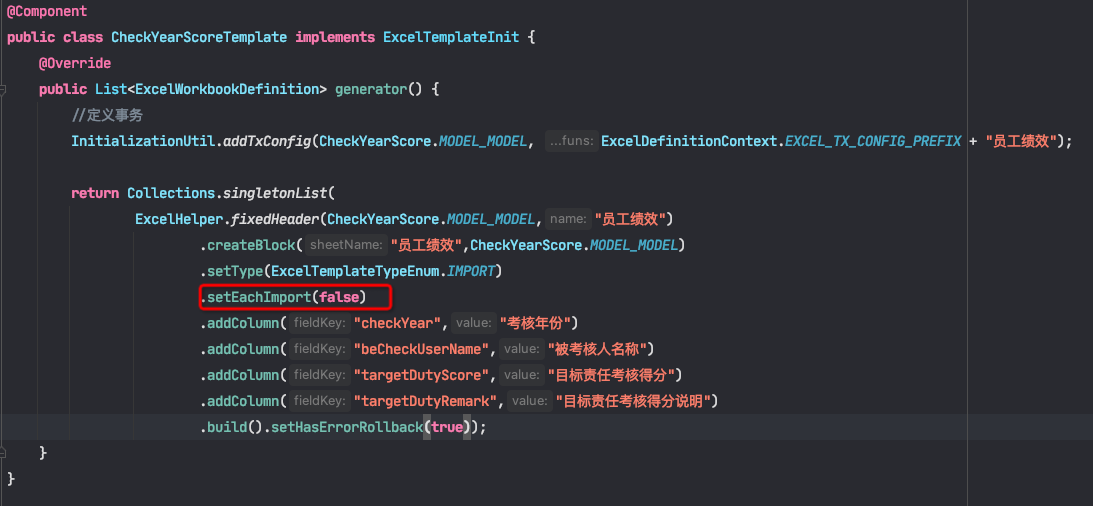
Excel导入扩展点-整体导入(批量导入)

2)导入扩展点API定义

pro.shushi.pamirs.file.api.extpoint.ExcelImportDataExtPoint#importData

3)示例代码参考:

pro.shushi.pamirs.translate.extpoint.ResourceTranslationImportExtPoint#importData

@Slf4j
@Component
@Ext(ExcelImportTask.class)
public class ResourceTranslationImportExtPoint extends AbstractExcelImportDataExtPointImpl<List<ResourceTranslationItem>> {

    @Override
    //TODO 表达式,可以自定义,比如可以支持1个模型的多个【导入名称】的不同模板
    @ExtPoint.Implement(expression = "importContext.definitionContext.model==\"" + ResourceTranslation.MODEL_MODEL + "\"")
    public Boolean importData(ExcelImportContext importContext, List<ResourceTranslationItem> dataList) {
        //TODO dataList就是excel导入那个sheet的所有内容

        return true;
    }

}

2、【导入】逐行导入的时候做事务控制

在模板中定义中增加事务的定义,并设置异常后回滚。参加示例代码:

excel模板定义

@Component
public class DemoItemImportTemplate implements ExcelTemplateInit {

    public static final String TEMPLATE_NAME = "商品导入模板";

    @Override
    public List<ExcelWorkbookDefinition> generator() {
        //定义事务(导入处理中,只操作单个表的不需要事务定义。)
        //是否定义事务根据实际业务逻辑确定。比如:有些场景在导入前需要删除数据后在进行导入就需要定义事务
        InitializationUtil.addTxConfig(DemoItem.MODEL_MODEL, ExcelDefinitionContext.EXCEL_TX_CONFIG_PREFIX + TEMPLATE_NAME);

        return Collections.singletonList(
                ExcelHelper.fixedHeader(DemoItem.MODEL_MODEL, TEMPLATE_NAME)
                        .setType(ExcelTemplateTypeEnum.IMPORT)
                        .createSheet("商品导入-sheet1")
                        .createBlock(DemoItem.MODEL_MODEL)
                        .addUnique(DemoItem.MODEL_MODEL,"name")
                        .addColumn("name","名称")
                        .addColumn("description","描述")
                        .addColumn("itemPrice","单价")
                        .addColumn("inventoryQuantity","库存")
                        .build().setEachImport(true)
                        //TODO 设置异常后回滚的标识,这个地方会回滚事务
                        .setHasErrorRollback(true)
                        .setExcelImportMode(ExcelImportModeEnum.SINGLE_MODEL)
        );

    }
}

导入逻辑处理

@Slf4j
@Component
@Ext(ExcelImportTask.class)
public class DemoItemImportExtPoint extends AbstractExcelImportDataExtPointImpl<DemoItem> implements ExcelImportDataExtPoint<DemoItem> {

    @Autowired
    private DemoItemService demoItemService;

    @Override
    @ExtPoint.Implement(expression = "importContext.definitionContext.model == \"" + DemoItem.MODEL_MODEL + "\"")
    public Boolean importData(ExcelImportContext importContext, DemoItem data) {
        ExcelImportTask importTask = importContext.getImportTask();
        try {
            DemoItemImportTask hrExcelImportTask = new DemoItemImportTask().queryById(importTask.getId());

            String publishUserName = Optional.ofNullable(hrExcelImportTask).map(DemoItemImportTask::getPublishUserName).orElse(null);
            data.setPublishUserName(publishUserName);

            demoItemService.create(data);
        } catch(PamirsException e) {
            log.error("导入异常", e);
        } catch (Exception e) {
            log.error("导入异常", e);
        }
        return Boolean.TRUE;
    }
}

Oinone社区 作者:望闲原创文章,如若转载,请注明出处:https://doc.oinone.top/backend/4856.html

访问Oinone官网:https://www.oinone.top获取数式Oinone低代码应用平台体验

(0)
望闲的头像望闲数式管理员
上一篇 2023年12月5日 pm6:17
下一篇 2023年12月18日 am9:59

相关推荐

  • 如何重写获取首页的方法

    介绍 用户登录成功后或者访问网页不带任何路由参数的时候前端会请求全局的首页的视图动作viewAction配置,然后跳转到该视图动作viewAction 方案 我们可以通过在该方法的后置hook自定义获取首页的逻辑,下面以按角色跳转不同首页的需求示例 package pro.shushi.pamirs.demo.core.hook; import org.apache.commons.collections4.CollectionUtils; import org.springframework.stereotype.Component; import pro.shushi.pamirs.auth.api.model.AuthRole; import pro.shushi.pamirs.boot.base.enmu.BaseExpEnumerate; import pro.shushi.pamirs.boot.base.model.ViewAction; import pro.shushi.pamirs.boot.web.loader.PageLoadAction; import pro.shushi.pamirs.demo.api.model.DemoItemCategory; import pro.shushi.pamirs.demo.api.model.DemoItemLabel; import pro.shushi.pamirs.meta.annotation.Hook; import pro.shushi.pamirs.meta.api.CommonApiFactory; import pro.shushi.pamirs.meta.api.core.faas.HookAfter; import pro.shushi.pamirs.meta.api.dto.fun.Function; import pro.shushi.pamirs.meta.api.session.PamirsSession; import pro.shushi.pamirs.meta.common.exception.PamirsException; import pro.shushi.pamirs.user.api.model.PamirsUser; import java.util.List; import java.util.stream.Collectors; @Component public class DemoHomepageHook implements HookAfter { private static final String TEST_ROLE_CODE_01 = "ROLE_1211"; private static final String TEST_ROLE_CODE_02 = "ROLE_1211_1"; @Override @Hook(module = {"base"}, model = {ViewAction.MODEL_MODEL}, fun = {"homepage"}) public Object run(Function function, Object ret) { if (ret == null) { return null; } ViewAction viewAction = getViewActionByCurrentRole(); if (viewAction != null) { ViewAction retNew = CommonApiFactory.getApi(PageLoadAction.class).load(viewAction); ViewAction viewActionRet = (ViewAction) ((Object[]) ret)[0]; viewActionRet.set_d(retNew.get_d()); } return ret; } protected ViewAction getViewActionByCurrentRole() { try { PamirsUser user = new PamirsUser(); user.setId(PamirsSession.getUserId()); user.fieldQuery(PamirsUser::getRoles); List<AuthRole> roles = user.getRoles(); if (CollectionUtils.isNotEmpty(roles)) { List<String> roleCodes = roles.stream().map(AuthRole::getCode).collect(Collectors.toList()); if (roleCodes.contains(TEST_ROLE_CODE_01)) { return new ViewAction().setModel(DemoItemCategory.MODEL_MODEL).setName("DemoMenus_ItemPMenu_DemoItemAndCateMenu_DemoItemCategoryMenu").queryOne(); } else if (roleCodes.contains(TEST_ROLE_CODE_02)) { return new ViewAction().setModel(DemoItemLabel.MODEL_MODEL).setName("DemoMenus_ItemPMenu_DemoItemAndCateMenu_DemoItemLabelMenu").queryOne(); } } } catch (PamirsException exception) { if (PamirsSession.getUserId() == null) { throw PamirsException.construct(BaseExpEnumerate.BASE_USER_NOT_LOGIN_ERROR, exception.getCause()).errThrow(); } else { throw exception; } } return null; } }

    2024年7月6日
    2.4K00
  • 流程设计流程结束通知SPI接口

    1.实现SPI接口 import pro.shushi.pamirs.meta.common.spi.SPI; import pro.shushi.pamirs.meta.common.spi.factory.SpringServiceLoaderFactory; import pro.shushi.pamirs.workflow.app.api.entity.WorkflowContext; import pro.shushi.pamirs.workflow.app.api.model.WorkflowInstance; @SPI(factory = SpringServiceLoaderFactory.class) public interface WorkflowEndNoticeApi { void execute(WorkflowContext context, WorkflowInstance instance); } 自定义通知逻辑 /** * 自定义扩展流程结束时扩展点 */ @Order(999) @Component @SPI.Service public class MyWorkflowEndNoticeApi implements WorkflowEndNoticeApi { @Override public void execute(WorkflowContext context, WorkflowInstance instance) { Long dataBizId = instance.getDataBizId(); //todo自定义逻辑 } }

    2023年12月26日
    1.2K00
  • 全局首页及应用首页配置方法(homepage)

    1 Oinone平台首页介绍 1.1 首页包括全局首页和应用首页两类 全局首页:指用户在登录时未指定重定向地址的情况下使用的应用首页 应用首页:指用户在切换应用时使用的首页 PS:全局首页本质上也是应用首页,是在用户没有指定应用时使用的首页。如登录后。 1.2 全局首页查找规则 找到当前用户有权限访问的全部应用。 若使用AppConfig配置首页,则优先使用该配置作为全局首页。若未指定或无权限访问,则继续第3步。 依次按照应用优先级,获取有权限的首页或菜单作为全局首页。 若未查找到任何可访问页面,则提示无权限访问相关异常,用户无法进入平台。 1.3 应用首页查找规则 在指定应用下,获取有权限的首页或菜单作为应用首页。 若未查找到任何可访问页面,则提示无权限访问相关异常,用户进入应用后无法正常查看或操作。 2 配置全局首页 2.1 使用应用优先级设置全局首页 /** * 演示模块 * * @author Adamancy Zhang at 16:55 on 2024-03-24 */ @UxHomepage(@UxRoute(DemoDepartment.MODEL_MODEL)) @Component @Boot @Module( name = DemoModule.MODULE_NAME, displayName = "演示应用", version = "1.0.0", dependencies = {ModuleConstants.MODULE_BASE}, priority = 0 ) @Module.module(DemoModule.MODULE_MODULE) @Module.Advanced(selfBuilt = true) public class DemoModule implements PamirsModule { public final static String MODULE_MODULE = "demo"; public final static String MODULE_NAME = "demo"; @Override public String[] packagePrefix() { return new String[]{"pro.shushi.pamirs.demo"}; } } 注意事项 @UxHomepage用于指定应用首页 @Module#priority用于指定模块优先级,按升序排列 PS:下面描述的内容不再提供完整的模块定义内容,仅针对@UxHomepage进行介绍。 3 配置应用首页 3.1 使用@UxHomepage配置应用首页 指定模型的默认表格视图作为应用首页 @UxHomepage(@UxRoute(DemoDepartment.MODEL_MODEL)) 该指定方式将产生以下结果: 生成一个跳转动作(ViewAction),其模型编码为DemoDepartment.MODEL_MODEL,动作名称为homepage。 设置ModuleDefinition#homePageModel和ModuleDefinition#homePageName为该跳转动作。 指定模型对应的菜单作为应用首页 在当前应用下有如下菜单定义: /** * 演示模块菜单 * * @author Adamancy Zhang at 17:16 on 2024-03-24 */ @UxMenus public class DemoMenus { @UxMenu("演示部门") @UxRoute(DemoDepartment.MODEL_MODEL) class DepartmentManagement { } @UxMenu("演示员工") @UxRoute(DemoEmployee.MODEL_MODEL) class EmployeeManagement { } } 根据菜单定义我们可以知道: 演示部门这个菜单会生成一个跳转动作(ViewAction),其模型编码为DemoDepartment.MODEL_MODEL,动作名称为DemoMenus_DepartmentManagement。 因此,我们可以使用如下方式指定应用首页为演示部门这个菜单: @UxHomepage(actionName = "DemoMenus_DepartmentManagement", value = @UxRoute(DemoDepartment.MODEL_MODEL)) 4 在应用中心修改应用首页 在平台启动之后,将无法通过代码的方式修改首页,因此需要在应用中心修改应用首页。 按照如下图所示操作对应用首页进行设置。 在绑定菜单选项中,选择指定菜单即可。

    2024年3月24日
    1.7K00
  • Oinone远程调用链路源码分析

    前提 源码分析版本是 5.1.x版本 概要 在服务启动时,获取注解REMOTE的函数,通过dubbo的泛化调用发布。在调用函数时,通过dubbo泛化调用获取结果。 注册服务者 在spring 启动方法installOrLoad中初始化 寻找定义REMOTE的方法 组装dubbo的服务配置 组装服务对象实现引用,内容如下,用于注册 调用前置处理 放信息到SessionApi 函数调用链追踪,放到本地TransmittableThreadLocal 从redis中获取到的数据进行反序列化并存在到本地的线程里 Trace信息,放一份在sessionApi中 和ThreadLocal 调用函数执行 返回数据转成特定格式 通过线程组调用dubbo的ServiceConfig.export 服务发布 时序图 源码分析 根据条件判断,确定向dubbo进行服务发布RemoteServiceLoader public void publishService(List<FunctionDefinition> functionList,Map<String,Runnable> isPublished) { // 因为泛化接口只能控制到namespace,控制粒度不能到fun级别,这里进行去重处理 Map<String, Function> genericNamespaceMap = new HashMap<>(); for (FunctionDefinition functionDefinition : functionList) { Function function = new Function(functionDefinition) try { //定义REMOTE, 才给予远程调用 if (FunctionOpenEnum.REMOTE.in(function.getOpen()) && !ClassUtils.isInterface(function.getClazz())) { genericNamespaceMap.putIfAbsent(RegistryUtils.getRegistryInterface(function), function); } } catch (PamirsException e) { } } // 发布远程服务 for (String namespace : genericNamespaceMap.keySet()) { Function function = genericNamespaceMap.get(namespace); if(isPublished.get(RegistryUtils.getRegistryInterface(function)) == null){ // 发布,注册远程函数服务,底层使用dubbo的泛化调用 Runnable registryTask = () -> remoteRegistry.registryService(function); isPublished.put(RegistryUtils.getRegistryInterface(function),registryTask); }else{ } } } 构造ServiceConfig方法,设置成泛化调用,进行发布export()DefaultRemoteRegistryComponent public void registryGenericService(String interfaceName, List<MethodConfig> methods, String group, String version, Integer timeout, Integer retries) { …. try { ServiceConfig<GenericService> service = new ServiceConfig<>(); // 服务接口名 service.setInterface(interfaceName); // 服务对象实现引用 service.setRef(genericService(interfaceName)); if (null != methods) { service.setMethods(methods); } // 声明为泛化接口 service.setGeneric(Boolean.TRUE.toString()); // 基础元数据 constructService(group, version, timeout, retries, service); service.export(); } catch (Exception e) { ….. } } // 服务对象实现引用 private GenericService genericService(String interfaceName) { return (method, parameterTypes, args) -> { PamirsSession.clear(); Function function = Objects.requireNonNull(PamirsSession.getContext()).getFunction(RegistryUtils.getFunctionNamespace(method), RegistryUtils.getFunctionFun(method)); if (log.isDebugEnabled()) { log.debug("interfaceName: " + interfaceName + ",…

    2024年9月4日
    1.4K00
  • 字段类型之关系描述的特殊场景(常量关联)

    场景概述 【字段类型之关系与引用】一文中已经描述了各种关系字段的常规写法,还有一些特殊场景如:关系映射中存在常量,或者M2M中间表是大于两个字段构成。 场景描述 1、PetTalent模型增加talentType字段2、PetItem与PetTalent的多对多关系增加talentType(达人类型),3、PetItemRelPetTalent中间表维护petItemId、petTalentId以及talentType,PetDogItem和PetCatItem分别重写petTalents字段,关系中增加常量描述。示意图如下: 实际操作步骤 Step1 新增 TalentTypeEnum package pro.shushi.pamirs.demo.api.enumeration; import pro.shushi.pamirs.meta.annotation.Dict; import pro.shushi.pamirs.meta.common.enmu.BaseEnum; @Dict(dictionary = TalentTypeEnum.DICTIONARY,displayName = "达人类型") public class TalentTypeEnum extends BaseEnum<TalentTypeEnum,Integer> { public static final String DICTIONARY ="demo.TalentTypeEnum"; public final static TalentTypeEnum DOG =create("DOG",1,"狗达人","狗达人"); public final static TalentTypeEnum CAT =create("CAT",2,"猫达人","猫达人"); } Step2 PetTalent模型增加talentType字段 package pro.shushi.pamirs.demo.api.model; import pro.shushi.pamirs.demo.api.enumeration.TalentTypeEnum; import pro.shushi.pamirs.meta.annotation.Field; import pro.shushi.pamirs.meta.annotation.Model; @Model.model(PetTalent.MODEL_MODEL) @Model(displayName = "宠物达人",summary="宠物达人",labelFields ={"name"}) public class PetTalent extends AbstractDemoIdModel{ public static final String MODEL_MODEL="demo.PetTalent"; @Field(displayName = "达人") private String name; @Field(displayName = "达人类型") private TalentTypeEnum talentType; } Step3 修改PetItem的petTalents字段,在关系描述中增加talentType(达人类型) @Field.many2many(relationFields = {"petItemId"},referenceFields = {"petTalentId","talentType"},through = PetItemRelPetTalent.MODEL_MODEL ) @Field.Relation(relationFields = {"id"}, referenceFields = {"id","talentType"}) @Field(displayName = "推荐达人",summary = "推荐该商品的达人们") private List<PetTalent> petTalents; Step4 PetDogItem增加petTalents字段,重写父类PetItem的关系描述 talentType配置为常量,填入枚举的值 增加domain描述用户页面选择的时候自动过滤出特定类型的达人,RSQL用枚举的name @Field(displayName = "推荐达人") @Field.many2many( through = "PetItemRelPetTalent", relationFields = {"petItemId"}, referenceFields = {"petTalentId","talentType"} ) @Field.Relation(relationFields = {"id"}, referenceFields = {"id", "#1#"}, domain = " talentType == DOG") private List<PetTalent> petTalents; Step5 PetCatItem增加petTalents字段,重写父类PetItem的关系描述 talentType配置为常量,填入枚举的值 增加domain描述用户页面选择的时候自动过滤出特定类型的达人,RSQL用枚举的name @Field(displayName = "推荐达人") @Field.many2many( through = "PetItemRelPetTalent", relationFields = {"petItemId"}, referenceFields = {"petTalentId","talentType"} ) @Field.Relation(relationFields = {"id"}, referenceFields = {"id", "#2#"}, domain = " talentType == CAT") private List<PetTalent> petTalents; Step6 PetCatItem增加petTalents字段,many2one关系示例 talentType配置为常量,填入枚举的值 增加domain描述用户页面选择的时候自动过滤出特定类型的达人,RSQL用枚举的name @Model.model(PetPet.MODEL_MODEL) @Model(displayName…

    2024年5月25日
    1.8K00

Leave a Reply

登录后才能评论