框架之MessageHub(信息提示)

框架之信息概述

后端除了可以返回错误信息以外,还可以返回调试、告警、成功、信息等级别的信息给前端。但是默认情况下前端只提示错误信息,可以通过前端的统一配置放开提示级别,有点类似后端的日志级别。

框架之MessageHub

在oinone平台中,我们怎么做到友好的错误提示呢?接下来介绍我们的MessageHub,它为自定义错误提示提供无限的可能。

何时使用

错误提示是用户体验中特别重要的组成部分,大部分的错误体现在整页级别,字段级别,按钮级别。友好的错误提示应该是怎么样的呢?我们假设他是这样的

  • 与用户操作精密契合
    • 当字段输入异常时,错误展示在错误框底部
    • 按钮触发服务时异常,错误展示在按钮底部
  • 区分不同的类型
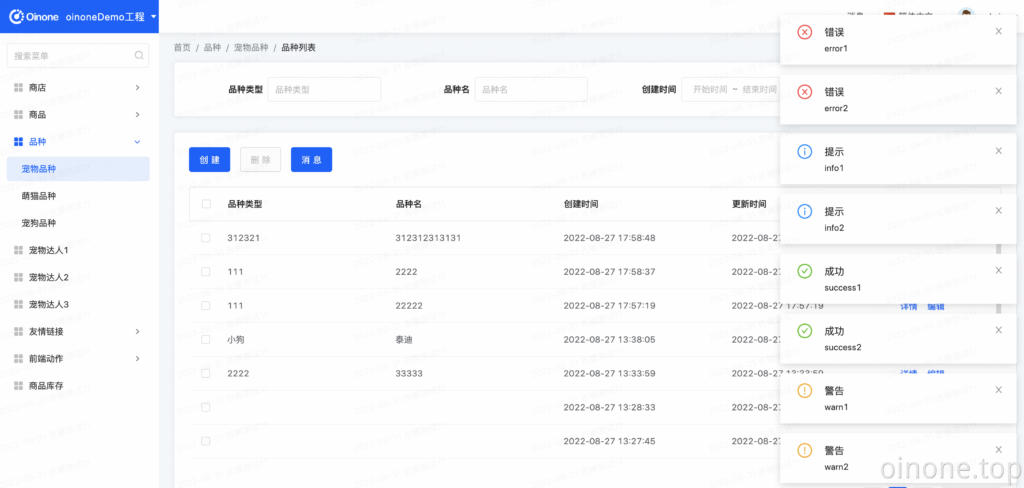
    • 错误
    • 成功
    • 警告
    • 提示
    • 调试
  • 简洁易懂的错误信息

不同信息类型的举例

package pro.shushi.pamirs.demo.core.action;

import org.springframework.stereotype.Component;
import pro.shushi.pamirs.demo.api.model.PetCatItem;
import pro.shushi.pamirs.demo.api.model.PetType;
import pro.shushi.pamirs.meta.annotation.Action;
import pro.shushi.pamirs.meta.annotation.Model;
import pro.shushi.pamirs.meta.api.dto.common.Message;
import pro.shushi.pamirs.meta.api.session.PamirsSession;
import pro.shushi.pamirs.meta.enmu.ActionContextTypeEnum;
import pro.shushi.pamirs.meta.enmu.InformationLevelEnum;
import pro.shushi.pamirs.meta.enmu.ViewTypeEnum;

@Model.model(PetType.MODEL_MODEL)
@Component
public class PetTypeAction {

    @Action(displayName = "消息",bindingType = ViewTypeEnum.TABLE,contextType = ActionContextTypeEnum.CONTEXT_FREE)
    public PetType message(PetType data){
        PamirsSession.getMessageHub().info("info1");
        PamirsSession.getMessageHub().info("info2");
        PamirsSession.getMessageHub().error("error1");
        PamirsSession.getMessageHub().error("error2");
        PamirsSession.getMessageHub().msg(new Message().msg("success1").setLevel(InformationLevelEnum.SUCCESS));
        PamirsSession.getMessageHub().msg(new Message().msg("success2").setLevel(InformationLevelEnum.SUCCESS));
        PamirsSession.getMessageHub().msg(new Message().msg("debug1").setLevel(InformationLevelEnum.DEBUG));
        PamirsSession.getMessageHub().msg(new Message().msg("debug2").setLevel(InformationLevelEnum.DEBUG));
        PamirsSession.getMessageHub().msg(new Message().msg("warn1").setLevel(InformationLevelEnum.WARN));
        PamirsSession.getMessageHub().msg(new Message().msg("warn2").setLevel(InformationLevelEnum.WARN));
        return data;
    }
}

查询运行返回和效果

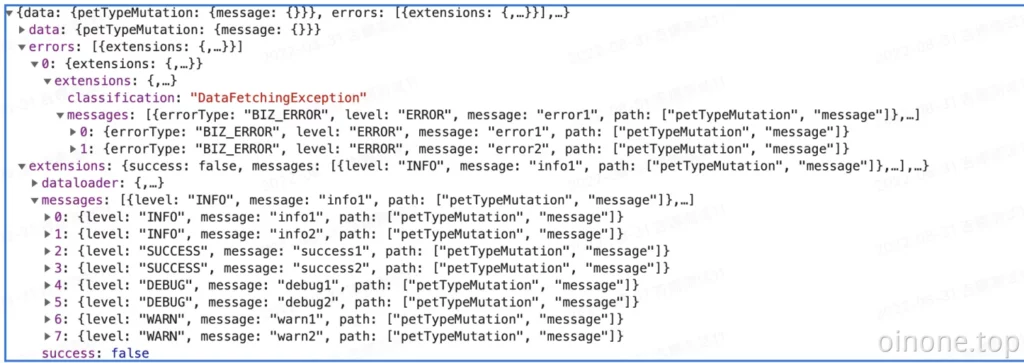
1)系统提示的返回结果
框架之MessageHub(信息提示)

2)系统提示示例效果
框架之MessageHub(信息提示)

Oinone社区 作者:望闲原创文章,如若转载,请注明出处:https://doc.oinone.top/backend/7237.html

访问Oinone官网:https://www.oinone.top获取数式Oinone低代码应用平台体验

(0)
望闲的头像望闲数式管理员
上一篇 2024年5月14日 pm10:04
下一篇 2024年5月15日 pm7:27

相关推荐

  • 【PostgreSQL】后端部署使用PostgreSQL数据库

    PostgreSQL数据库配置 驱动配置 Maven配置(14.3版本可用) <postgresql.version>42.6.0</postgresql.version> <dependency> <groupId>org.postgresql</groupId> <artifactId>postgresql</artifactId> <version>${postgresql.version}</version> </dependency> 离线驱动下载 postgresql-42.2.18.jarpostgresql-42.6.0.jarpostgresql-42.7.3.jar JDBC连接配置 pamirs: datasource: base: type: com.alibaba.druid.pool.DruidDataSource driverClassName: org.postgresql.Driver url: jdbc:postgresql://127.0.0.1:5432/pamirs?currentSchema=base username: xxxxxx password: xxxxxx 连接url配置 暂无官方资料 url格式 jdbc:postgresql://${host}:${port}/${database}?currentSchema=${schema} 在jdbc连接配置时,${database}和${schema}必须完整配置,不可缺省。 其他连接参数如需配置,可自行查阅相关资料进行调优。 方言配置 pamirs方言配置 pamirs: dialect: ds: base: type: PostgreSQL version: 14 major-version: 14.3 pamirs: type: PostgreSQL version: 14 major-version: 14.3 数据库版本 type version majorVersion 14.x PostgreSQL 14 14.3 PS:由于方言开发环境为14.3版本,其他类似版本(14.x)原则上不会出现太大差异,如出现其他版本无法正常支持的,可在文档下方留言。 schedule方言配置 pamirs: event: enabled: true schedule: enabled: true dialect: type: PostgreSQL version: 14 major-version: 14.3 type version majorVersion PostgreSQL 14 14.3 PS:由于schedule的方言在多个版本中并无明显差异,目前仅提供一种方言配置。 其他配置 逻辑删除的值配置 pamirs: mapper: global: table-info: logic-delete-value: (EXTRACT(epoch FROM CURRENT_TIMESTAMP) * 1000000 + EXTRACT(MICROSECONDS FROM CURRENT_TIMESTAMP))::bigint PostgreSQL数据库用户初始化及授权 — init root user (user name can be modified by oneself) CREATE USER root WITH PASSWORD 'password'; — if using automatic database and schema creation, this is very important. ALTER USER root CREATEDB; SELECT * FROM pg_roles; — if using postgres database, this authorization is required. GRANT CREATE ON DATABASE postgres TO root;

    2023年11月1日
    1.2K00
  • Dubbo配置详解

    概述 Dubbo是一款高性能、轻量级的开源Java RPC框架,它提供了三大核心能力:面向接口的远程方法调用,智能容错和负载均衡,以及服务自动注册和发现。 Oinone平台默认使用dubbo-v2.7.22版本,本文以该版本为例进行描述。 基本概念 Dubbo在注册provider/consumer时使用Netty作为RPC调用的核心服务,其具备客户端/服务端(C/S)的基本特性。即:provider作为服务端,consumer作为客户端。 客户端通过服务中心发现有服务可被调用时,将通过服务中心提供的服务端调用信息,连接服务端并发起请求,从而实现远程调用。 服务注册(绑定Host/Port) JAVA程序启动时,需要将provider的信息注册到服务中心,并在当前环境为Netty服务开启Host/Port监听,以实现服务注册功能。 在下文中,我们通过绑定Host/Port表示Netty服务的访问地址,通过注册Host/Port表示客户端的访问地址。 使用yaml配置绑定Host/Port PS:该配置可在多种环境中通用,改变部署方式无需修改此配置。 dubbo: protocol: name: dubbo # host: 0.0.0.0 port: -1 假设当前环境的可用IP为192.168.1.100 以上配置将使得Netty服务默认绑定在0.0.0.0:20880地址,服务注册地址为192.168.1.100:20880 客户端将通过192.168.1.100:20880调用服务端服务 若发生20880端口占用,则自动向后查找可用端口。如20881、20882等等 若当前可用端口为20881,则以上配置将使得Netty服务默认绑定在0.0.0.0:20881地址,服务注册地址为192.168.1.100:20881 使用环境变量配置注册Host/Port 当服务端被放置在容器环境中时,由于容器环境的特殊性,其内部的网络配置相对于宿主机而言是独立的。因此为保证客户端可以正常调用服务端,还需在容器中配置环境变量,以确保客户端可以通过指定的注册Host/Port进行访问。 以下示例为体现无法使用20880端口的情况,将宿主机可访问端口从20880改为20881。 DUBBO_IP_TO_REGISTRY=192.168.1.100 DUBBO_PORT_TO_REGISTRY=20881 假设当前宿主机环境的可用IP为192.168.1.100 以上配置将使得Netty服务默认绑定在0.0.0.0:20881地址,服务注册地址为192.168.1.100:20881 客户端将通过192.168.1.100:20881调用服务端服务 使用docker/docker-compose启动 需添加端口映射,将20881端口映射至宿主机20881端口。(此处容器内的端口发生变化,若需要了解具体原因,可参考题外话章节) docker-run IP=192.168.1.100 docker run -d –name designer-allinone-full \ -e DUBBO_IP_TO_REGISTRY=$IP \ -e DUBBO_PORT_TO_REGISTRY=20881 \ -p 20881:20881 \ docker-compose services: backend: container_name: designer-backend image: harbor.oinone.top/oinone/designer-backend-v5.0 restart: always environment: DUBBO_IP_TO_REGISTRY: 192.168.1.100 DUBBO_PORT_TO_REGISTRY: 20881 ports: – 20881:20881 # dubbo端口 使用kubernetes启动 工作负载(Deployment) kind: Deployment apiVersion: apps/v1 spec: replicas: 1 template: spec: containers: – name: designer-backend image: harbor.oinone.top/oinone/designer-backend-v5.0 ports: – name: dubbo containerPort: 20881 protocol: TCP env: – name: DUBBO_IP_TO_REGISTRY value: "192.168.1.100" – name: DUBBO_PORT_TO_REGISTRY value: "20881" 服务(Services) kind: Service apiVersion: v1 spec: type: NodePort ports: – name: dubbo protocol: TCP port: 20881 targetPort: dubbo nodePort: 20881 PS:此处的targetPort为对应Deployment#spec. template.spec.containers.ports.name配置的端口名称。若未配置,可使用20881直接指定对应容器的端口号。 使用kubernetes其他暴露服务方式 在Kubernetes中部署服务,有多种配置方式均可用暴露服务。上述配置仅用于通过Service/NodePort将20881端口暴露至宿主机,其他服务可用通过任意Kubernetes节点IP进行调用。 若其他服务也在Kubernetes中进行部署,则可以通过Service/Service方式进行调用。将DUBBO_IP_TO_REGISTRY配置为${serviceName}.${namespace}即可。 若其他服务无法直接访问Kubernetes的master服务,则可以通过Ingress/Service方式进行调用。将DUBBO_IP_TO_REGISTRY配置为Ingress可解析域名即可。 Dubbo调用链路图解 PS: Consumer的绑定Host/Port是其作为Provider使用的,下面所有图解仅演示单向的调用链路。 名词解释 Provider: 服务提供者(JVM) Physical Machine Provider: 服务提供者所在物理机 Provider Container: 服务提供者所在容器 Kubernetes Service: Kubernetes Service资源类型 Consumer: 服务消费者(JVM) Registration Center: 注册中心;可以是zookeeper、nacos等。 bind: 服务绑定Host/Port到指定ip:port。 registry: 服务注册;注册Host/Port到注册中心的信息。 discovery: 服务发现;注册Host/Port到消费者的信息。 invoke: 服务调用;消费者通过注册中心提供的提供者信息向提供者发起服务调用。 forward: 网络转发;通常在容器环境需要进行必要的网络转发,以使得服务调用可以到达服务提供者。 物理机/物理机调用链路 “` mermaidsequenceDiagram participant p as Provider<br>(bind 0.0.0.0:20880)participant m as Physical Machine Provider<br>(bind 192.168.1.100:20881)participant…

    2024年8月10日
    1.7K00
  • 【OpenGauss】后端部署使用OpenGauss高斯数据库

    Gauss数据库配置 适配版本 4.7.8.3之后的版本 配置步骤 Maven配置 去华为官网下周驱动包:gsjdbc4.jar;https://support.huaweicloud.com/mgtg-dws/dws_01_0032.html <dependency> <groupId>org.postgresql</groupId> <artifactId>gsjdbc</artifactId> <version>4</version> <scope>system</scope> <!– 下面两种方式都可以–> <systemPath>${pom.basedir}/libs/gsjdbc4.jar</systemPath> <!–<systemPath>/Users/wangxian/java-tools/guassdb/gsjdbc4.jar</systemPath>–> </dependency> 导入 scope 为 system 的包,spring 编译插件需要增加 includeSystemScope: true 配置。 <plugin> <groupId>org.springframework.boot</groupId> <artifactId>spring-boot-maven-plugin</artifactId> <configuration> <includeSystemScope>true</includeSystemScope> </configuration> <executions> <execution> <goals> <goal>repackage</goal> </goals> </execution> </executions> </plugin> JDBC连接配置 pamirs: datasource: pamirs: type: com.alibaba.druid.pool.DruidDataSource driverClassName: org.postgresql.Driver url: jdbc:postgresql://127.0.0.1:5432/pamirs?currentSchema=demo username: XXXXXX password: XXXXXX initialSize: 5 maxActive: 200 minIdle: 5 maxWait: 60000 timeBetweenEvictionRunsMillis: 60000 testWhileIdle: true testOnBorrow: false testOnReturn: false poolPreparedStatements: true asyncInit: true base: type: com.alibaba.druid.pool.DruidDataSource driverClassName: org.postgresql.Driver url: jdbc:postgresql://127.0.0.1:5432/pamirs?currentSchema=demo_base username: XXXXXX password: XXXXXX initialSize: 5 maxActive: 200 minIdle: 5 maxWait: 60000 timeBetweenEvictionRunsMillis: 60000 testWhileIdle: true testOnBorrow: false testOnReturn: false poolPreparedStatements: true asyncInit: true 连接url配置 点击查看官方文档:官方文档 url格式 jdbc:postgresql://${host}:${port}/${database}?currentSchema=${schema} 在pamirs连接配置时,${database}和${schema}必须完整配置,不可缺省。 其他连接参数如需配置,可自行查阅相关资料进行调优。 方言配置 pamirs方言配置 pamirs: dialect: ds: base: type: GaussDB version: 5 majorVersion: 5.0.1 pamirs: type: GaussDB version: 5 majorVersion: 5.0.1 数据库版本 type version majorVersion 5.x GaussDB 5 5.0.1 PS:由于方言开发环境为5.0.1版本,其他类似版本(5.x)原则上不会出现太大差异,如出现其他版本无法正常支持的,可在文档下方留言。 schedule方言配置 pamirs: event: enabled: true schedule: enabled: true dialect: type: GaussDB version: 5 major-version: 5.0.1 type version majorVersion GaussDB 5 5.0.1 PS:由于schedule的方言在多个版本中并无明显差异,目前仅提供一种方言配置。 其他配置 逻辑删除的值配置 pamirs: mapper: global: table-info: logic-delete-value: (EXTRACT(epoch FROM CURRENT_TIMESTAMP) * 1000000 + EXTRACT(MICROSECONDS FROM CURRENT_TIMESTAMP))::bigint Gauss数据库用户初始化及授权 — init root…

    2024年3月27日
    2.2K00
  • DsHint(指定数据源)和BatchSizeHint(指定批次数量)

    概述和使用场景 DsHintApi ,强制指定数据源, BatchSizeHintApi ,强制指定查询批量数量 API定义 DsHintApi public static DsHintApi model(String model/**模型编码*/) { // 具体实现 } public DsHintApi(Object dsKey/***数据源名称*/) { // 具体实现 } BatchSizeHintApi public static BatchSizeHintApi use(Integer batchSize) { // 具体实现 } 使用示例 1、【注意】代码中使用 try-with-resources语法; 否则可能会出现数据源错乱 2、DsHintApi使用示例包裹在try里面的所有查询都会强制使用指定的数据源 // 使用方式1: try (DsHintApi dsHintApi = DsHintApi.model(PetItem.MODEL_MODEL)) { List<PetItem> items = demoItemDAO.customSqlDemoItem(); PetShopProxy data2 = data.queryById(); data2.fieldQuery(PetShopProxy::getPetTalents); } // 使用方式2: try (DsHintApi dsHintApi = DsHintApi.use("数据源名称")) { List<PetItem> items = demoItemDAO.customSqlDemoItem(); PetShopProxy data2 = data.queryById(); data2.fieldQuery(PetShopProxy::getPetTalents); } 3、BatchSizeHintApi使用示例包裹在try里面的所有查询都会按照指定的batchSize进行查询 // 查询指定每次查询500跳 try (BatchSizeHintApi batchSizeHintApi = BatchSizeHintApi.use(500)) { PetShopProxy data2 = data.queryById(); data2.fieldQuery(PetShopProxy::getPetTalents); } // 查询指定不分页(batchSize=-1)查询。 请注意,你必须在明确不需要分页查询的情况下使用;如果数据量超大不分页可能会卡死。默认不指定分页数的情况下下平台会进行分页查询 try (BatchSizeHintApi batchSizeHintApi = BatchSizeHintApi.use(-1)) { PetShopProxy data2 = data.queryById(); data2.fieldQuery(PetShopProxy::getPetTalents); }

    2024年5月18日
    1.4K00
  • 自定义RSQL占位符(placeholder)及在权限中使用

    1 自定义RSQL占位符常用场景 统一的数据权限配置 查询表达式的上下文变量扩展 2 自定义RSQL的模板 /** * 演示Placeholder占位符基本定义 * * @author Adamancy Zhang at 13:53 on 2024-03-24 */ @Component public class DemoPlaceHolder extends AbstractPlaceHolderParser { private static final String PLACEHOLDER_KEY = "${thisPlaceholder}"; /** * 占位符 * * @return placeholder */ @Override public String namespace() { return PLACEHOLDER_KEY; } /** * 占位符替换值 * * @return the placeholder replace to the value */ @Override protected String value() { return PamirsSession.getUserId().toString(); } /** * 优先级 * * @return execution order of placeholders, ascending order. */ @Override public Integer priority() { return 0; } /** * 是否激活 * * @return the placeholder is activated */ @Override public Boolean active() { return true; } } 注意事项 在一些旧版本中,priority和active可能不起作用,为保证升级时不受影响,请保证该属性配置正确。 PLACEHOLDER_KEY变量表示自定义占位符使用的关键字,需按照所需业务场景的具体功能并根据上下文语义正确定义。 为保证占位符可以被正确替换并执行,所有占位符都不应该出现重复,尤其是不能与系统内置的重复。 3 占位符使用时的优先级问题 多个占位符在进行替换时,会根据优先级按升序顺序执行,如需要指定替换顺序,可使用Spring的Order注解对其进行排序。 import org.springframework.core.annotation.Order; @Order(0) 4 Oinone平台内置的占位符 占位符 数据类型 含义 备注 ${currentUser} String 当前用户ID 未登录时无法使用 ${currentRoles} Set<String> 当前用户的角色ID集合 未登录时无法使用 5 如何覆盖平台内置的占位符? 通过指定占位符的优先级,并定义相同的namespace可优先替换。 6 如何定义会话级别的上下文变量? 在上述模板中,我们使用的是Oinone平台内置的上下文变量进行演示,通常情况下,我们需要根据实际业务场景增加上下文变量,以此来实现所需功能。 下面,我们将根据当前用户获取当前员工ID定义该上下文变量进行演示。 /** * 员工Session * * @author Adamancy Zhang at 14:33 on 2024-03-24 */ @Component public class EmployeeSession implements HookBefore { private static final String SESSION_KEY = "CUSTOM_EMPLOYEE_ID"; @Autowired private DemoEmployeeService demoEmployeeService; public static String getEmployeeId() { return PamirsSession.getTransmittableExtend().get(SESSION_KEY);…

    2024年3月24日
    1.6K00

Leave a Reply

登录后才能评论