4.1.9 函数之元位指令

元位指令系统是通过给请求上下文的指令位字段作按位与标记来对函数处理下发对应指令的系统。

一、元位指令介绍

元位指令系统是通过给请求上下文的指令位字段作按位与标记来对函数处理下发对应指令的系统。

元位指令系统分为请求上下文指令和数据指令两种。

数据指令

数据指令基本都是系统内核指令。业务开发时用不到这里就不介绍了。前20位都是系统内核预留

请求上下文指令

请求上下文指令:使用session上下文中非持久化META_BIT属性设置指令。

指令 指令名 前端默认值 后端默认值 描述
20 builtAction 内建动作 是否是平台内置定义的服务器动作对应操作:PamirsSession.directive().disableBuiltAction(); PamirsSession.directive().enableBuiltAction();
21 unlock 失效乐观锁 系统对带有乐观锁模型默认使用乐观锁对应操作:PamirsSession.directive().enableOptimisticLocker(); PamirsSession.directive().disableOptimisticLocker();
22 check 数据校验 系统后端操作默认不进行数据校验,标记后生效数据校验对应操作:PamirsSession.directive().enableCheck(); PamirsSession.directive().disableCheck();
23 defaultValue 默认值计算 是否自动填充默认值对应操作:PamirsSession.directive().enableDefaultValue(); PamirsSession.directive().disableDefaultValue();
24 extPoint 执行扩展点 前端请求默认执行扩展点,可以标记忽略扩展点。后端编程式调用数据管理器默认不执行扩展点对应操作:PamirsSession.directive().enableExtPoint(); PamirsSession.directive().disableExtPoint();
25 hook 拦截 是否进行函数调用拦截对应操作:PamirsSession.directive().enableHook(); PamirsSession.directive().disableHook();
26 authenticate 鉴权 系统默认进行权限校验与过滤,标记后使用权限校验对应操作:PamirsSession.directive().sudo(); PamirsSession.directive().disableSudo();
27 ormColumn ORM字段别名 系统指令,请勿设置
28 usePkStrategy 使用PK策略 使用PK是否空作为采用新增还是更新的持久化策略对应操作:PamirsSession.directive().enableUsePkStrategy(); PamirsSession.directive().disableUsePkStrategy();
29 fromClient 是否客户端调用 是否客户端(前端)调用对应操作:PamirsSession.directive().enableFromClient(); PamirsSession.directive().disableFromClient();
30 sync 同步执行函数 异步执行函数强制使用同步方式执行(仅对Spring Bean有效)
31 ignoreFunManagement 忽略函数管理 忽略函数管理器处理,防止Spring调用重复拦截对应操作:PamirsSession.directive().enableIgnoreFunManagement(); PamirsSession.directive().disableIgnoreFunManagement();

表4-1-9-1 请求上下文指令

二、使用指令

普通模式

PamirsSession.directive().disableOptimisticLocker();
try{
    更新逻辑
} finally {
    PamirsSession.directive().enableOptimisticLocker();
}

图4-1-9-1 普通模式代码示意

批量设置模式

Models.directive().run(() -> {此处添加逻辑}, SystemDirectiveEnum.AUTHENTICATE)

图4-1-9-2 批量设置模式代码示意

三、使用举例

我们在4.1.5【模型之持久层配置】一文中提到过失效乐观锁,我们在这里就尝试下吧。

Step1 修改PetItemInventroyAction

手动失效乐观锁

package pro.shushi.pamirs.demo.core.action;

import org.springframework.stereotype.Component;
import pro.shushi.pamirs.demo.api.model.PetItemInventroy;
import pro.shushi.pamirs.meta.annotation.Function;
import pro.shushi.pamirs.meta.annotation.Model;
import pro.shushi.pamirs.meta.api.session.PamirsSession;
import pro.shushi.pamirs.meta.constant.FunctionConstants;
import pro.shushi.pamirs.meta.enmu.FunctionOpenEnum;
import pro.shushi.pamirs.meta.enmu.FunctionTypeEnum;

import java.util.ArrayList;
import java.util.List;

@Model.model(PetItemInventroy.MODEL_MODEL)
@Component
public class PetItemInventroyAction {

    @Function.Advanced(type= FunctionTypeEnum.UPDATE)
    @Function.fun(FunctionConstants.update)
    @Function(openLevel = {FunctionOpenEnum.API})
    public PetItemInventroy update(PetItemInventroy data){
        List<PetItemInventroy> inventroys = new ArrayList<>();
        inventroys.add(data);
        PamirsSession.directive().disableOptimisticLocker();
        try{
            //批量更新会,自动抛错
            int i = data.updateBatch(inventroys);
            //单记录更新,不自动抛售需要自行判断
//        int i = data.updateById();
//        if(i!=1){
//            throw PamirsException.construct(DemoExpEnumerate.PET_ITEM_INVENTROY_UPDATE_VERSION_ERROR).errThrow();
//        }
        } finally {
            PamirsSession.directive().enableOptimisticLocker();
        }
        return data;
    }

}

图4-1-9-3 修改PetItemInventroyAction

Step2 重启看效果

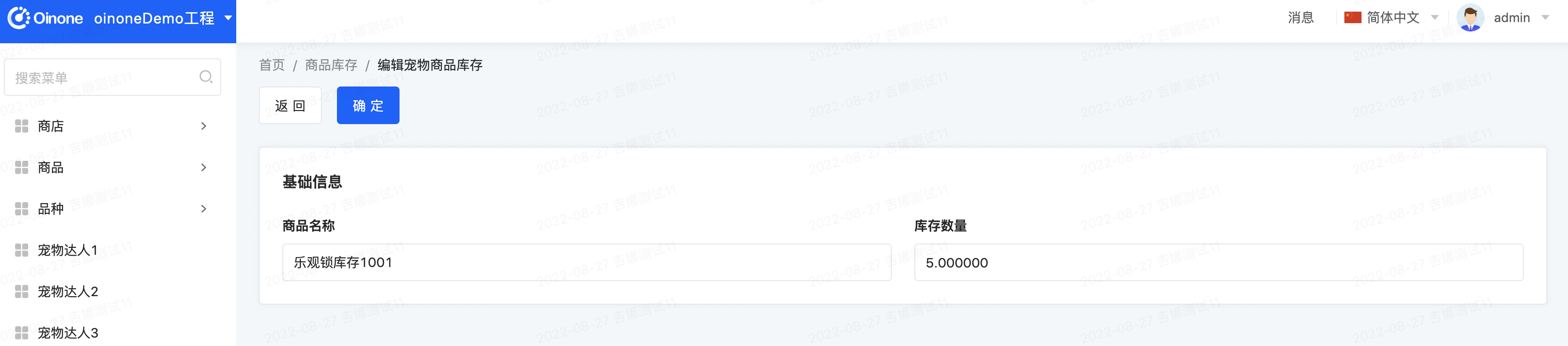
体验一:页面上修改记录,数据库字段中的opt_version不再自动加一
体验二:同时打两个页面,依次点击,您会发现两次都成功。数据库字段中的opt_version不再自动加一
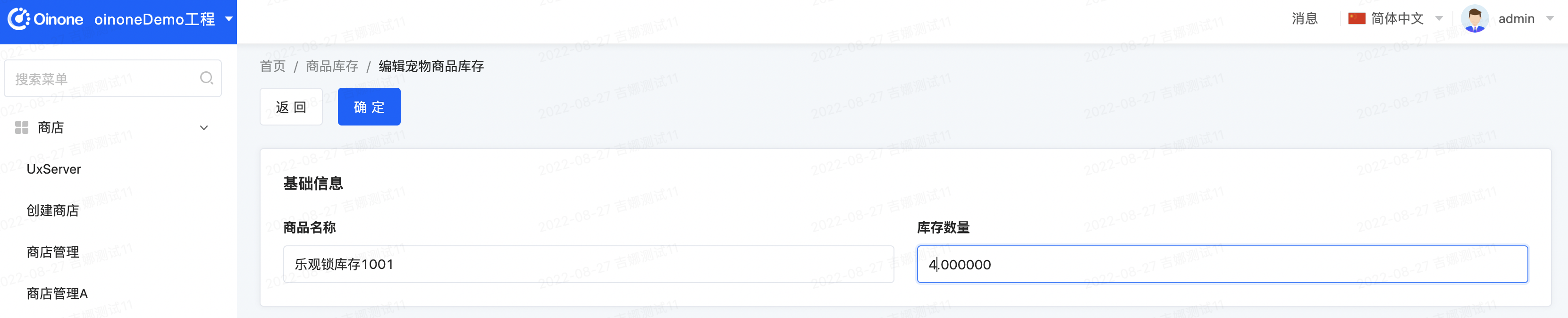
image.png

图4-1-9-4 编辑宠物商品库存

image.png

图4-1-9-5 编辑宠物商品库存

image.png

图4-1-9-6 宠物商品库存的数据库记录变化

Oinone社区 作者:史, 昂原创文章,如若转载,请注明出处:https://doc.oinone.top/oio4/9284.html

访问Oinone官网:https://www.oinone.top获取数式Oinone低代码应用平台体验

Like (0)
史, 昂's avatar史, 昂数式管理员
Previous 2024年5月23日 am8:54
Next 2024年5月23日 am8:56

相关推荐

  • 3.5.2.3 构建View的Layout

    在日常需求中也经常需要调整Layout的情况,如出现树表结构(左树右表、级联),我们则需要通过修改View的Layout来完成。今天就带您学习下Layout的自定义 第一个表格Layout 如果我们想去除表格视图区域的搜索区、ActionBar(操作区),就可以为视图自定义一个简单的Layout就行啦 Step1 新建一个表格的Layout 在views/demo_core/layout路径下增加一个名为sample_table_layout.xml文件,name设置为sampleTableLayout <view type="TABLE" name="sampleTableLayout"> <!– <view type="SEARCH">–> <!– <pack widget="fieldset">–> <!– <element widget="search" slot="search" slotSupport="field"/>–> <!– </pack>–> <!– </view>–> <pack widget="fieldset" style="height: 100%" wrapperStyle="height: 100%"> <pack widget="row" style="height: 100%; flex-direction: column"> <!– <pack widget="col" mode="full" style="flex: 0 0 auto">–> <!– <element widget="actionBar" slot="actionBar" slotSupport="action">–> <!– <xslot name="actions" slotSupport="action" />–> <!– </element>–> <!– </pack>–> <pack widget="col" mode="full" style="min-height: 234px"> <element widget="table" slot="table" slotSupport="field"> <xslot name="fields" slotSupport="field" /> <element widget="rowAction" slot="rowActions" slotSupport="action"/> </element> </pack> </pack> </pack> </view> 图3-5-2-27 新建一个表格的Layout Step2 修改宠物达人自定义表格Template 在view标签上增加layout属性值为"sampleTableLayout" <view name="tableView" model="demo.PetTalent" cols="1" type="TABLE" enableSequence="true" layout="sampleTableLayout"> ……省略其他 </view> 图3-5-2-28 修改宠物达人自定义表格Template Step3 重启看效果 图3-5-2-29 示例效果 Step4 修改宠物达人自定义表格Template 去除在view标签上的layout属性配置,让其回复正常 第一个树表Layout 本节以“给商品管理页面以树表的方式增加商品类目过滤”为例 Step1 增加商品类目模型 增加PetItemCategory模型继承CodeModel,新增两个字段定义name和parent,其中parent字段M2O关联自身模型,非必填字段(如字段值为空即为一级类目): package pro.shushi.pamirs.demo.api.model; import pro.shushi.pamirs.meta.annotation.Field; import pro.shushi.pamirs.meta.annotation.Model; import pro.shushi.pamirs.meta.base.common.CodeModel; @Model.model(PetItemCategory.MODEL_MODEL) @Model(displayName = "宠物商品类目",summary="宠物商品类目",labelFields={"name"}) public class PetItemCategory extends CodeModel { public static final String MODEL_MODEL="demo.PetItemCategory"; @Field(displayName = "类目名称",required = true) private String name; @Field(displayName = "父类目") @Field.many2one private PetItemCategory parent; } 图3-5-2-30 增加商品类目模型 Step2 修改自定义商品模型 为商品模型PetItem增加一个category字段m2o关联PetItemCategory @Field(displayName = "类目") @Field.many2one private PetItemCategory category; 图3-5-2-31 修改宠物商品模型 Step3 新增名为treeTableLayout的Layout 在views/demo_core/layout路径下增加一个名为tree_table_layout.xml文件,name设置为treeTableLayout 图3-5-2-32 新增名为treeTableLayout的Layout <view type="TABLE" name="treeTableLayout"> <view type="SEARCH"> <pack widget="fieldset"> <element widget="search" slot="search" slotSupport="field"/> </pack> </view> <pack…

    2024年5月23日
    1.4K00
  • 致Oinone读者

    欢迎来到Oinone生态,我们为您提供了一站式低代码商业支撑平台,数式科技已经用其服务了如中烟、得力、上海电气、中航金网、雾芯科技等多个知名企业,我们的技术实力在商业场景得到了很好的验证。我们希望通过开源Oinone项目,为中国软件行业带来变革,提升整体工程化水平,与广大软件工程师一起为客户创造价值!《Oinone 7天从入门到精通》一书是Oinone开源项目的配套书籍,系统化地介绍了如何基于Oinone开源项目,快速开发高质量的软件系统。此外,如果您开发的项目是用于商业化而非企业自用,我们还为您提供了一种可选的商业化变现途径:申请成为Oinone的合作伙伴,并提交相关产品,详情请访问 www.oinone.top 网站。 书籍纲领 本书的章节安排如下: 第一章至第二章:【揭开面纱,理解Oinone】和【Oinone的技术独特性】。这两个章节可以帮助您更好地理解我们设计Oinone的初衷以及特性的由来。 第三章:面向研发人员的【Oinone的基础入门】。如果您是专业的研发人员,本章可以帮助您快速上手并做出业务系统。只要按着里面的case一步步操作下来就可以。 第四章至第六章:面向研发人员的【Oinone的高级特性】、【Oinone的CDM】、【Oinone的通用能力】。这三篇章节重点介绍了Oinone的高级技术特性、提供的通用数据模型和通用基础能力。它们能够帮助我们更快地进行业务开发,从容应对业务的特殊场景要求,比较适合进阶的研发人员。 第七章:面向非研发人员的【Oinone的设计器们】和【Oinone的低无一体】。如果您并不是专业的研发人员,本章可以帮助您通过使用Oinone的无代码可视化设计器轻松自主解决业务需求,并且当可视化设计器满足不了的时候,您还可以在【Oinone的低无一体】中找到方式,并寻求研发帮助

    Oinone 7天入门到精通 2024年5月23日
    1.9K00
  • 4.5.2 研发辅助之SQL优化

    Oinone体系中是不需要针对模型写SQL的,默认提供了通用的数据管理器。在带来便利的情况下,也导致传统的sql审查就没办法开展。但是我们可以以技术的手段收集慢SQL和限制问题SQL执行。 慢SQL搜集目的:去发现非原则性问题的慢SQL,并进行整改 限制问题SQL执行:对应一些不规范的SQL系统上直接做限制,如果有特殊情况手动放开 一、发现慢SQL 这个功能并没有直接加入到oinone的版本中,需要业务自行写插件,插件代码如下。大家可以根据实际情况进行改造比如: 堆栈入口,例子中只是放了pamirs,可以根据实际情况改成业务包路径 对慢SQL的定义是5s还是3s,根据实际情况变 package pro.shushi.pamirs.demo.core.plugin; import org.apache.ibatis.executor.Executor; import org.apache.ibatis.mapping.MappedStatement; import org.apache.ibatis.plugin.*; import org.apache.ibatis.session.ResultHandler; import org.apache.ibatis.session.RowBounds; import org.springframework.stereotype.Component; import pro.shushi.pamirs.meta.annotation.fun.extern.Slf4j; @Intercepts({ @Signature(type = Executor.class,method = "query",args = {MappedStatement.class,Object.class, RowBounds.class, ResultHandler.class}) }) @Component @Slf4j public class SlowSQLAnalysisInterceptor implements Interceptor { @Override public Object intercept(Invocation invocation) throws Throwable { long start = System.currentTimeMillis(); Object result = invocation.proceed(); long end = System.currentTimeMillis(); if (end – start > 10000) {//大于10秒 try { StackTraceElement[] stackTraceElements = Thread.currentThread().getStackTrace(); StringBuffer slowLog = new StringBuffer(); slowLog.append(System.lineSeparator()); for (StackTraceElement element : stackTraceElements) { if (element.getClassName().indexOf("pamirs") > 0) { slowLog.append(element.getClassName()).append(":").append(element.getMethodName()).append(":").append(element.getLineNumber()).append(System.lineSeparator()); } } Object parameter = null; if (invocation.getArgs().length > 1) { parameter = invocation.getArgs()[1]; } MappedStatement mappedStatement = (MappedStatement) invocation.getArgs()[0]; BoundSql boundSql = mappedStatement.getBoundSql(parameter); Configuration configuration = mappedStatement.getConfiguration(); String originalSql = showSql(configuration, boundSql); originalSql = originalSql.replaceAll("\'", "").replace("\"", ""); log.warn("检测到的慢SQL为:" + originalSql); log.warn("业务慢SQL入口为:" + slowLog.toString()); } catch (Throwable e1) { //忽略 } } return result; } public String showSql(Configuration configuration, BoundSql boundSql) { Object parameterObject = boundSql.getParameterObject(); List<ParameterMapping> parameterMappings = boundSql.getParameterMappings(); String sql = boundSql.getSql().replaceAll("[\\s]+", " "); if (parameterMappings.size() > 0 && parameterObject != null) { TypeHandlerRegistry typeHandlerRegistry…

    Oinone 7天入门到精通 2024年5月23日
    1.7K00
  • 4.2.5 框架之网络请求-Request

    在中后台业务场景中,大部分的请求时候是可以被枚举的,比如创建、删除、更新、查询。在上文中,我们讲了httpClient如何自定义请求,来实现自己的业务诉求。本文中讲到的Request是离业务更近一步的封装,他提供了开箱即用的API,比如insertOne、updateOne,它是基于HttpClient做的二次封装,当你熟悉Request时,在中后台的业务场景中,所有的业务接口自定义将事半功倍。 一、Request详细介绍 元数据-model 获取模型实例 import { getModel } from '@kunlun/dependencies' getModel('modelName'); 图4-2-5-1 获取模型实例 清除所有缓存的模型 import { cleanModelCache } from '@kunlun/dependencies' cleanModelCache(); 图4-2-5-2 清除所有缓存的模型 元数据-module 获取应用实例,包含应用入口和菜单 import { queryModuleByName } from '@kunlun/dependencies' queryModuleByName('moduleName') 图4-2-5-3 获取应用实例 查询当前用户所有的应用 import { loadModules } from '@kunlun/dependencies' loadModules() 图4-2-5-4 查询当前用户所有的应用 query 分页查询 import { queryPage } from '@kunlun/dependencies' queryPage(modelName, { pageSize: 15, // 一次查询几条 currentPage, 1, // 当前页码 condition?: '' // 查询条件 maxDepth?: 1, // 查几层模型出来,如果有2,会把所有查询字段的关系字段都查出来 sort?: []; // 排序规则 }, fields, variables, context) 图4-2-5-5 分页查询 自定义分页查询-可自定义后端接口查询数据 import { customQueryPage } from '@kunlun/dependencies' customQueryPage(modelName, methodName, { pageSize: 15, // 一次查询几条 currentPage, 1, // 当前页码 condition?: '' // 查询条件 maxDepth?: 1, // 查几层模型出来,如果有2,会把所有查询字段的关系字段都查出来 sort?: []; // 排序规则 }, fields, variables, context) 图4-2-5-6 自定义分页查询 查询一条-根据params匹配出一条数据 import { queryOne } from '@kunlun/dependencies' customQueryPage(modelName, params, fields, variables, context) 图4-2-5-7 根据params匹配出一条数据 自定义查询 import { customQuery } from '@kunlun/dependencies' customQuery(methodName, modelName, record, fields, variables, context) 图4-2-5-8 自定义查询 update import { updateOne } from '@kunlun/dependencies' updateOne(modelName, record, fields, variables, context) 图4-2-5-9 update insert import { insertOne } from '@kunlun/dependencies' insertOne(modelName, record, fields, variables, context) 图4-2-5-10 insert delete import { deleteOne } from '@kunlun/dependencies'…

    2024年5月23日
    1.7K00
  • 企业个性化配置

    平台除了帮助企业快速解决业务需求外,还提供了企业文化、风格个性化能力,本章节详细介绍个性化配置。包括:登陆页配置、企业形象配置、系统风格配置。 系统配置 配置入口 配置入口:右上角登陆账号——系统配置——全局配置——登陆页配置、企业形象配置、系统风格配置。 登陆页配置 用户自定义登陆页的主题,一共有六个主题可选择,分别为: 图一:左侧是图片,右侧是登录输入框,Logo在左上角; 图二:右左侧是图片,右侧是登录输入框,Logo在左上角; 图三:底图是图片,登录输入框浮在页面左侧,Logo在左上角; 图四:底图是图片,登录输入框浮在页面中间,Logo在左上角; 图五:底图是图片,登录输入框浮在页面右侧,Logo在左上角; 图六:底图是图片,登录输入框浮在页面中间,Logo在登录框上方。 页面背景 上传登录页背景,支持上传jpg、png格式的图片或mp4、mov、avi格式视频。尺寸建议为1920*1080px,文件大小不超过50MB。 登录页logo:指配置登录页左上角的logo图标。 预览:配置后可在右侧电脑中点击全屏预览效果。 配置示例 企业形象配置 企业形象配置:可设置企业信息、业务应用导航栏logo、浏览器logo,设置完成之后,点击发布之后设置生效。 系统风格配置 系统风格配置,可设置主题(浅色、深色)、尺寸(大、中、小),配置后可全屏预览,发布后即可更换成对应的风格。 下载代码可进行自定义风格。

    2024年6月20日
    1.5K00

Leave a Reply

Please Login to Comment