6.3 数据审计(改)

在业务应用中我们经常需要为一些核心数据的变更做审计追踪,记录字段的前后变化、操作IP、操作人、操作地址等等。数据审计模块为此提供了支撑和统一管理。它在成熟的企业的核心业务系统中,需求是比较旺盛的。接下来我们开始学习下数据审计模块

准备工作

pamirs-demo-core的pom文件中引入pamirs-data-audit-api包依赖

<dependency>
    <groupId>pro.shushi.pamirs.core</groupId>
    <artifactId>pamirs-data-audit-api</artifactId>
</dependency>

pamirs-demo-boot的pom文件中引入pamirs-data-audit-core和pamirs-third-party-map-core包依赖,数据审计会记录操作人的地址信息,所以也依赖了pamirs-third-party-map-core

<dependency>
    <groupId>pro.shushi.pamirs.core</groupId>
    <artifactId>pamirs-data-audit-core</artifactId>
</dependency>
<dependency>
    <groupId>pro.shushi.pamirs.core.map</groupId>
    <artifactId>pamirs-third-party-map-core</artifactId>
</dependency>

pamirs-demo-boot的application-dev.yml文件中增加配置pamirs.boot.modules增加data_audit 和third_party_map,即在启动模块中增加data_audit和third_party_map模块


pamirs:
    boot:
    modules:
      - data_audit
      - tp_map

为third_party_map模块增加高德接口api,下面e439dda234467b07709f28b57f0a9bd5换成自己的key

pamirs: 
    eip:
    map:
        gd:
        key: e439dda234467b07709f28b57f0a9bd5

数据审计

注解式(举例)

Step1 新增PetTalentDataAudit数据审计定义类

package pro.shushi.pamirs.demo.core.init.audit;

import pro.shushi.pamirs.data.audit.api.annotation.DataAudit;
import pro.shushi.pamirs.demo.api.model.PetTalent;

@DataAudit(
        model = PetTalent.MODEL_MODEL,//需要审计的模型
        modelName = "宠物达人" ,//模型名称,默认模型对应的displayName
        //操作名称
        optTypes = {PetTalentDataAudit.PETTALENT_CREATE,PetTalentDataAudit.PETTALENT_UDPATE},
        fields={"nick","picList.id","picList.url","petShops.id","petShops.shopName"}//需要审计的字段,关系字段用"."连结
)
public class PetTalentDataAudit {
    public static final String PETTALENT_CREATE ="宠物达人创建";
    public static final String PETTALENT_UDPATE ="宠物达人修改";

Step2 修改PetTalentAction的update方法

做审计日志埋点:手工调用 OperationLogBuilder.newInstance().record()方法。需要注意的是这里需要把原有记录的数据值先查出来做对比

    @Function.Advanced(type= FunctionTypeEnum.UPDATE)
    @Function.fun(FunctionConstants.update)
    @Function(openLevel = {FunctionOpenEnum.API})
    public PetTalent update(PetTalent data){
        //记录日志
        OperationLogBuilder.newInstance(PetTalent.MODEL_MODEL, PetTalentDataAudit.PETTALENT_UDPATE).record(data.queryById().fieldQuery(PetTalent::getPicList).fieldQuery(PetTalent::getPetShops),data);

        PetTalent existPetTalent = new PetTalent().queryById(data.getId());
        if(existPetTalent !=null){
            existPetTalent.fieldQuery(PetTalent::getPicList);
            existPetTalent.fieldQuery(PetTalent::getPetShops);
            existPetTalent.relationDelete(PetTalent::getPicList);
            existPetTalent.relationDelete(PetTalent::getPetShops);
        }
        data.updateById();
        data.fieldSave(PetTalent::getPicList);
        data.fieldSave(PetTalent::getPetShops);
        return data;
    }

Step3 重启看效果

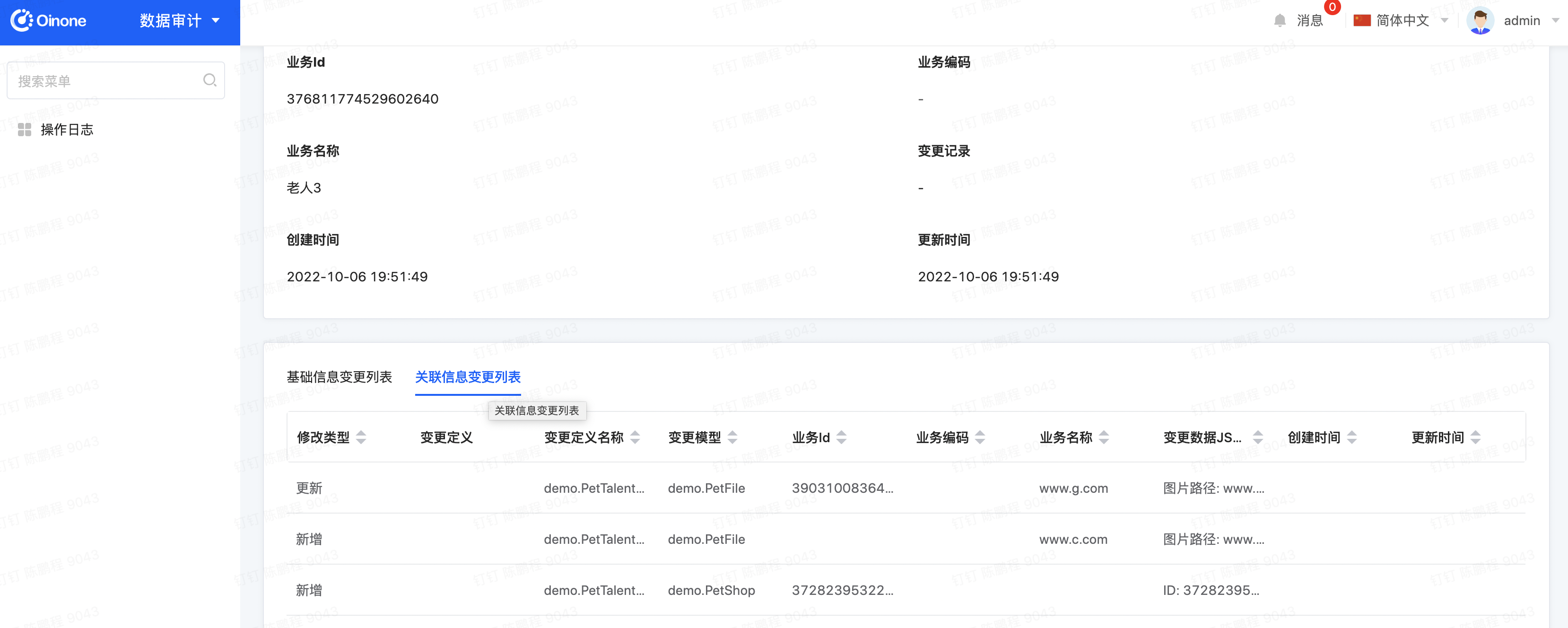
修改宠物达人记录对应的字段,然后进入审计模块查看日志
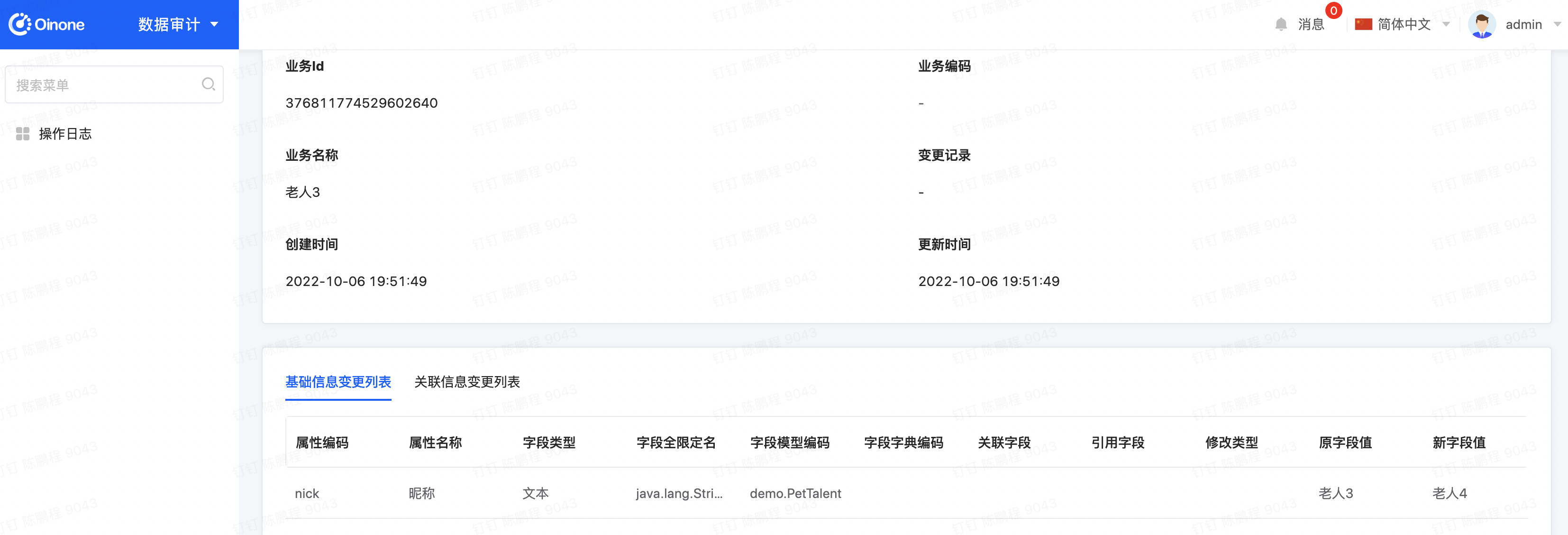
image.png

image.png

Oinone社区 作者:史, 昂原创文章,如若转载,请注明出处:https://doc.oinone.top/oio4/9327.html

访问Oinone官网:https://www.oinone.top获取数式Oinone低代码应用平台体验

(0)
史, 昂的头像史, 昂数式管理员
上一篇 2024年5月23日 am8:11
下一篇 2024年5月23日 am8:13

相关推荐

  • 3.5.7.3 自定义布局

    布局是什么 在系统中,布局决定了母版内的页面元素,一个页面可以由多个组件进行组装,布局可以根据视图类型来替换。 默认布局范围: 图3-5-7-36 默认布局范围 作用场景 系统内置了多个布局组件,这些组件适用于全局、某个应用或某个页面,提供了灵活的布局定制选项。这些组件根据不同类型的视图进行了默认的组装,这也是选择了视图类型后,页面能够呈现的原因。当然,这些默认的组装是可以被覆盖、新增和添加新组件的。 使用registerLayout进行自定义布局 开发者在使用这些布局组件时,应该遵循公司的规范进行统一的调整。自定义布局组件的使用可通过 registerLayout 实现。registerLayout 的第一个参数是代表布局的 XML,第二个参数是不同的选项维度,默认包含以下维度: viewType: 视图类型 module: 视图模型所在模块 moduleName: 视图模型所在模块名称 model: 视图模型编码 modelName: 视图模型名称 viewName: 视图名称 actionName: 动作名称 inline: 是否内嵌视图(子视图特有) ttype: 模型字段类型(子视图特有) relatedTtype: 关联模型字段类型(子视图特有) field: 字段(子视图特有) 需要注意的是,动作可以是A模块下的a模型,这个动作可以打开B模块下的b模型的视图,module、moduleName、model、modelName应该填b模型对应的值,只不过大部分场景我们都是本模型的动作打开本模型的视图,所以这些场景拿动作所在模型填这些值也可以这些纬度也可以通过查看TS的定义查看 全局 在系统中,我们可以通过指定视图类型来决定某一类视图的全局布局。以表格为例,当第二个入参为 { viewType: ViewType.Table } 时,代表了替换了系统内所有表格的布局样式。 示例工程目录 以下是需关注的工程目录示例,main.ts更新导入./layout,layout/index.ts更新导出./tableLayout: 图3-5-7-37 全局纬度注册布局工程目录示例 示例代码 import {registerLayout, ViewType} from '@kunlun/dependencies' /** * 把系统内所有表格类型视图的全局动作放入搜索区域 * * 移动actionBar布局至外层 * <element widget="actionBar" slot="actionBar" slotSupport="action"> * <xslot name="actions" slotSupport="action" /> * </element> * */ const registerGlobalTableLayout = () => { return registerLayout(`<view type="TABLE"> <element widget="actionBar" slot="actionBar" slotSupport="action"> <xslot name="actions" slotSupport="action" /> </element> <pack widget="group"> <view type="SEARCH"> <element widget="search" slot="search" slotSupport="field" /> </view> </pack> <pack widget="group" slot="tableGroup"> <element widget="table" slot="table" slotSupport="field"> <element widget="expandColumn" slot="expandRow" /> <xslot name="fields" slotSupport="field" /> <element widget="rowActions" slot="rowActions" slotSupport="action" /> </element> </pack> </view>`, { viewType: ViewType.Table }) } registerGlobalTableLayout() 图3-5-7-38 全局纬度注册布局代码示例 效果 图3-5-7-39 全局纬度注册布局效果示例 应用 在系统中,我们可以通过指定视图类型和模块名称来替换某一类视图在特定模块下的全局布局。以表格为例,当第二个入参为 { viewType: ViewType.Table, moduleName: ‘resource’ } 时,代表了替换了资源应用下所有表格的布局样式,而其他应用仍使用默认布局 import {registerLayout, ViewType} from '@kunlun/dependencies' const registerModuleTableLayout = () => { return registerLayout(`<view type="TABLE"> <element widget="actionBar" slot="actionBar" slotSupport="action"> <xslot name="actions" slotSupport="action" /> </element> <pack widget="group"> <view type="SEARCH"> <element widget="search" slot="search" slotSupport="field" /> </view> </pack> <pack…

    2024年5月23日
    1.2K00
  • 4.1.9 函数之元位指令

    元位指令系统是通过给请求上下文的指令位字段作按位与标记来对函数处理下发对应指令的系统。 一、元位指令介绍 元位指令系统是通过给请求上下文的指令位字段作按位与标记来对函数处理下发对应指令的系统。 元位指令系统分为请求上下文指令和数据指令两种。 数据指令 数据指令基本都是系统内核指令。业务开发时用不到这里就不介绍了。前20位都是系统内核预留 请求上下文指令 请求上下文指令:使用session上下文中非持久化META_BIT属性设置指令。 位 指令 指令名 前端默认值 后端默认值 描述 20 builtAction 内建动作 否 否 是否是平台内置定义的服务器动作对应操作:PamirsSession.directive().disableBuiltAction(); PamirsSession.directive().enableBuiltAction(); 21 unlock 失效乐观锁 否 否 系统对带有乐观锁模型默认使用乐观锁对应操作:PamirsSession.directive().enableOptimisticLocker(); PamirsSession.directive().disableOptimisticLocker(); 22 check 数据校验 是 否 系统后端操作默认不进行数据校验,标记后生效数据校验对应操作:PamirsSession.directive().enableCheck(); PamirsSession.directive().disableCheck(); 23 defaultValue 默认值计算 是 否 是否自动填充默认值对应操作:PamirsSession.directive().enableDefaultValue(); PamirsSession.directive().disableDefaultValue(); 24 extPoint 执行扩展点 是 否 前端请求默认执行扩展点,可以标记忽略扩展点。后端编程式调用数据管理器默认不执行扩展点对应操作:PamirsSession.directive().enableExtPoint(); PamirsSession.directive().disableExtPoint(); 25 hook 拦截 是 否 是否进行函数调用拦截对应操作:PamirsSession.directive().enableHook(); PamirsSession.directive().disableHook(); 26 authenticate 鉴权 是 否 系统默认进行权限校验与过滤,标记后使用权限校验对应操作:PamirsSession.directive().sudo(); PamirsSession.directive().disableSudo(); 27 ormColumn ORM字段别名 否 否 系统指令,请勿设置 28 usePkStrategy 使用PK策略 是 否 使用PK是否空作为采用新增还是更新的持久化策略对应操作:PamirsSession.directive().enableUsePkStrategy(); PamirsSession.directive().disableUsePkStrategy(); 29 fromClient 是否客户端调用 是 否 是否客户端(前端)调用对应操作:PamirsSession.directive().enableFromClient(); PamirsSession.directive().disableFromClient(); 30 sync 同步执行函数 否 否 异步执行函数强制使用同步方式执行(仅对Spring Bean有效) 31 ignoreFunManagement 忽略函数管理 否 否 忽略函数管理器处理,防止Spring调用重复拦截对应操作:PamirsSession.directive().enableIgnoreFunManagement(); PamirsSession.directive().disableIgnoreFunManagement(); 表4-1-9-1 请求上下文指令 二、使用指令 普通模式 PamirsSession.directive().disableOptimisticLocker(); try{ 更新逻辑 } finally { PamirsSession.directive().enableOptimisticLocker(); } 图4-1-9-1 普通模式代码示意 批量设置模式 Models.directive().run(() -> {此处添加逻辑}, SystemDirectiveEnum.AUTHENTICATE) 图4-1-9-2 批量设置模式代码示意 三、使用举例 我们在4.1.5【模型之持久层配置】一文中提到过失效乐观锁,我们在这里就尝试下吧。 Step1 修改PetItemInventroyAction 手动失效乐观锁 package pro.shushi.pamirs.demo.core.action; import org.springframework.stereotype.Component; import pro.shushi.pamirs.demo.api.model.PetItemInventroy; import pro.shushi.pamirs.meta.annotation.Function; import pro.shushi.pamirs.meta.annotation.Model; import pro.shushi.pamirs.meta.api.session.PamirsSession; import pro.shushi.pamirs.meta.constant.FunctionConstants; import pro.shushi.pamirs.meta.enmu.FunctionOpenEnum; import pro.shushi.pamirs.meta.enmu.FunctionTypeEnum; import java.util.ArrayList; import java.util.List; @Model.model(PetItemInventroy.MODEL_MODEL) @Component public class PetItemInventroyAction { @Function.Advanced(type= FunctionTypeEnum.UPDATE) @Function.fun(FunctionConstants.update) @Function(openLevel = {FunctionOpenEnum.API}) public PetItemInventroy update(PetItemInventroy data){ List<PetItemInventroy> inventroys = new ArrayList<>(); inventroys.add(data); PamirsSession.directive().disableOptimisticLocker(); try{ //批量更新会,自动抛错 int i = data.updateBatch(inventroys); //单记录更新,不自动抛售需要自行判断 // int i = data.updateById();…

    2024年5月23日
    86300
  • 4.1.14 Search之非存储字段条件

    search默认查询的是模型的queryPage函数,但我们有时候需要替换调用的函数,这个特性会在下个版本支持。其核心场景为当搜索条件中有非存储字段,如果直接用queryPage函数的rsql拼接就会报错,所以非存储字段不会增加在rsql中。本文介绍一个比较友好的临时替代方案。 非存储字段条件(举例) Step1 为PetTalent新增一个非存储字段unStore @Field(displayName = "非存储字段测试",store = NullableBoolEnum.FALSE) private String unStore; 图4-1-14-1 为PetTalent新增一个非存储字段unStore Step2 修改PetTalent的Table视图的Template 在标签内增加一个查询条件 <field data="unStore" /> 图4-1-14-2 修改PetTalent的Table视图的Template Step3 重启看效果 进入宠物达人列表页,在搜索框【非存储字段测试】输入查询内容,点击搜索跟无条件一致 Step4 修改PetTalentAction的queryPage方法 package pro.shushi.pamirs.demo.core.action; …… 引入依赖类 @Model.model(PetTalent.MODEL_MODEL) @Component public class PetTalentAction { ……其他代码 @Function.Advanced(type= FunctionTypeEnum.QUERY) @Function.fun(FunctionConstants.queryPage) @Function(openLevel = {FunctionOpenEnum.API}) public Pagination<PetTalent> queryPage(Pagination<PetTalent> page, IWrapper<PetTalent> queryWrapper){ QueryWrapper<PetTalent> queryWrapper1 = (QueryWrapper<PetTalent>) queryWrapper; Map<String, Object> queryData = queryWrapper.getQueryData(); String unStore = (String) queryData.get(LambdaUtil.fetchFieldName(PetTalent::getUnStore)); if (StringUtils.isNotEmpty(unStore)) { //转换查询条件 queryWrapper1.like( 图4-1-14-3 修改PetTalentAction的queryPage方法 Step5 重启看效果 在搜索框【非存储字段测试】输入查询内容,跟通过【达人】字段搜索的效果是一致的 图4-1-14-4 示例效果

    2024年5月23日
    1.1K00

Leave a Reply

登录后才能评论