
4.2.3 框架之SPI机制

SPI(Service Provider Interface)服务提供接口,是一套用来被第三方实现或者扩展的API,它可以用来启用框架扩展和替换组件,简单来说就是用来解耦,实现组件的自由插拔,这样我们就能在平台提供的基础组件外扩展新组件或覆盖平台组件。

目前定义SPI组件
ViewWidget 视图组件
FieldWidget 字段组件
ActionWidget 动作组件

表4-2-3-1 目前定义SPI组件

前提知识点

1. 通过注解定义一种SPI接口(Interface)

@SPI.Base<IViewFilterOptions, IView>('View', ['id', 'name', 'type', 'model', 'widget'])
export abstract class ViewWidget<ViewData = any> extends DslNodeWidget {

}

图4-2-3-1 代码示意

2. 通过注解注册提供View类型接口的一个或多个实现

@SPI.Base<IViewFilterOptions, IView>('View', ['id', 'name', 'type', 'model', 'widget'])
export abstract class ViewWidget<ViewData = any> extends DslNodeWidget {

}

图4-2-3-2 代码示意

3. 视图的xml内通过配置来调用已定义的一种SPI组件

<view widget="form" model="demo.shop">
  <field name="id" />
</view>
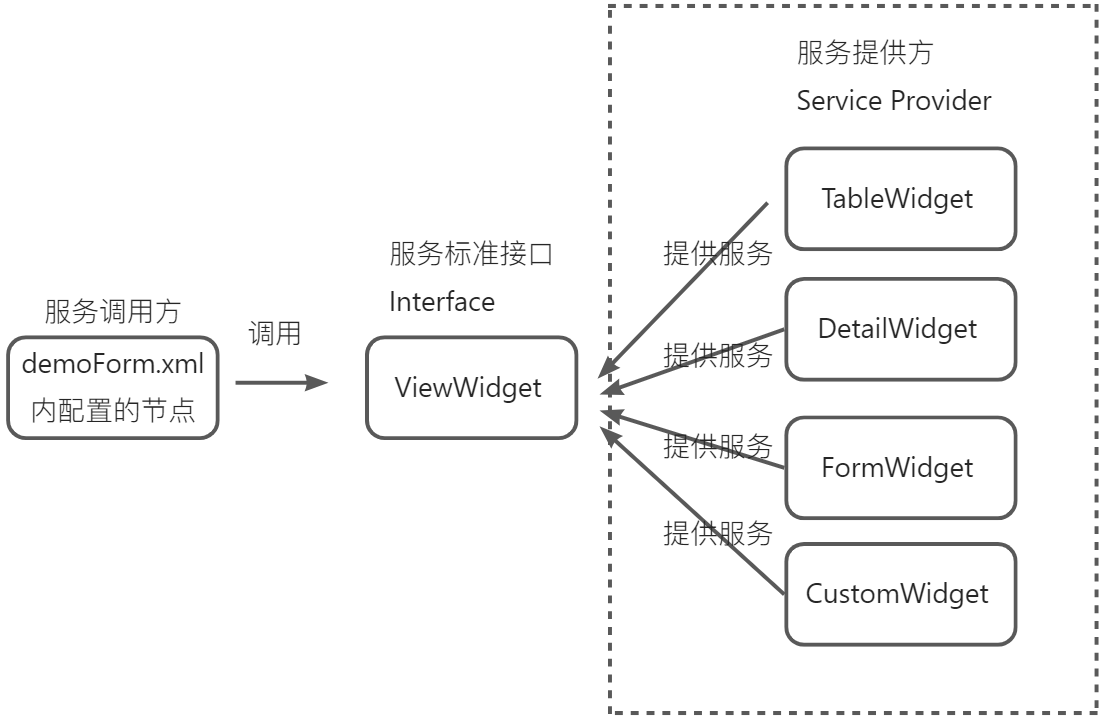
图4-2-3-3 代码示意

4.2.3 框架之SPI机制

图4-2-3-4 组件继承示意图

当有多个服务提供方时,按以下规则匹配出最符合条件的服务提供方

SPI匹配规则

SPI组件没有严格的按匹配选项属性限定,而是一个匹配规则

  1. 按widget最优先匹配,配置了widget等于是指定了需要调用哪个widget,此时其他属性直接忽略

  2. 按最大匹配原则(匹配到的属性越多优先级越高)

  3. 按后注册优先原则

Oinone社区 作者:史, 昂原创文章,如若转载,请注明出处:https://doc.oinone.top/oio4/9304.html

访问Oinone官网:https://www.oinone.top获取数式Oinone低代码应用平台体验

(0)
史, 昂的头像史, 昂数式管理员
上一篇 2024年5月23日 am8:34
下一篇 2024年5月23日 am8:36

相关推荐

  • 4.2.2 框架之MessageHub

    一、MessageHub 请求出现异常时,提供”点对点“的通讯能力 二、何时使用 错误提示是用户体验中特别重要的组成部分,大部分的错误体现在整页级别,字段级别,按钮级别。友好的错误提示应该是怎么样的呢?我们假设他是这样的 与用户操作精密契合 当字段输入异常时,错误展示在错误框底部 按钮触发服务时异常,错误展示在按钮底部 区分不同的类型 错误 成功 警告 提示 调试 简洁易懂的错误信息 在oinone平台中,我们怎么做到友好的错误提示呢?接下来介绍我们的MessageHub,它为自定义错误提示提供无限的可能。 三、如何使用 订阅 import { useMessageHub, ILevel } from "@kunlun/dependencies" const messageHub = useMessageHub('当前视图的唯一标识'); /* 订阅错误信息 */ messageHub.subscribe((errorResult) => { console.log(errorResult) }) /* 订阅成功信息 */ messageHub.subscribe((errorResult) => { console.log(errorResult) }, ILevel.SUCCESS) 图4-2-2-1 订阅的示例代码 销毁 /** * 在适当的时机销毁它 * 如果页面逻辑运行时都不需要销毁,在页面destroyed是一定要销毁,重要!!! */ messageHub.unsubscribe() 图4-2-2-2 销毁的示例代码 四、实战 让我们把3.5.7.5【自定义视图-表单】一文中的自定义表单进行改造,加入我们的messageHub,模拟在表单提交时,后端报错信息在字段下方给予提示。 Step1 (后端)重写PetType的创建函数 重写PetType的创建函数,在创建逻辑中通过MessageHub返回错误信息,返回错误信息的同时要设置paths信息方便前端处理 @Action.Advanced(name = FunctionConstants.create, managed = true) @Action(displayName = "确定", summary = "创建", bindingType = ViewTypeEnum.FORM) @Function(name = FunctionConstants.create) @Function.fun(FunctionConstants.create) public PetType create(PetType data){ List<Object> paths = new ArrayList<>(); paths.add("demo.PetType"); paths.add("kind"); PamirsSession.getMessageHub().msg(new Message().msg("kind error").setPath(paths).setLevel(InformationLevelEnum.ERROR).setErrorType(ErrorTypeEnum.BIZ_ERROR)); List<Object> paths2 = new ArrayList<>(); paths2.add("demo.PetType"); paths2.add("name"); PamirsSession.getMessageHub().msg(new Message().msg("name error").setPath(paths2).setLevel(InformationLevelEnum.ERROR).setErrorType(ErrorTypeEnum.BIZ_ERROR)); // data.create(); return data; } 图4-2-2-3 (后端)重写PetType的创建函数 Step 2 修改PetForm.vue <template> <div class="petFormWrapper"> <form :model="formState" @finish="onFinish"> <a-form-item label="品种种类" id="name" name="kind" :rules="[{ required: true, message: '请输入品种种类!', trigger: 'focus' }]"> <a-input v-model:value="formState.kind" @input="(e) => onNameChange(e, 'kind')" /> <span style="color: red">{{ getServiceError('kind') }}</span> </a-form-item> <a-form-item label="品种名" id="name" name="name" :rules="[{ required: true, message: '请输入品种名!', trigger: 'focus' }]"> <a-input v-model:value="formState.name" @input="(e) => onNameChange(e, 'name')" /> <span style="color: red">{{ getServiceError('name') }}</span> </a-form-item> </form> </div> </template>- <script lang="ts"> import { defineComponent, reactive…

    2024年5月23日
    1.2K00
  • 3.5.6.4 动作的配置

    在3.5.3【Action的类型】一文中,我们介绍Action的几种类型,以及组合动作。 通用配置 配置项 可选值 默认值 作用 name 动作名称 label 显示名称 icon 图标 type primary defaultlink primary 按钮类型样式,支持主要样式、次要样式以及链接样式。 bizStyle defaultsuccesswarningdangerinfo default 按钮业务样式,支持成功(green)、警告(yellow)、危险(red)、信息(grey)四种样式。 invisible truefalse condition false 展示规则,有简单的true/false显隐,也支持复杂的表达式 disabled truefalse condition 根据动作上下文类型进行自动推断 是否禁用自动推断规则:当上下文类型为【单行】时,相当于使用表达式LIST_COUNT(context.activeRecords) != 1当上下文类型为【多行】时,相当于使用表达式LIST_COUNT(context.activeRecords) <= 1当上下文类型为【单行或多行】时,相当于使用表达式LIST_COUNT(context.activeRecords) == 0 disabledTitle string 根据动作上下文类型进行自动推断 禁用悬浮提示 表3-5-6-12 动作通用配置 二次确认配置 二次确认框默认支持两种模式,对话框和气泡框; 对话框 图3-5-6-51 对话框提示 气泡框 图3-5-6-52 气泡框警告 配置项 配置项 可选值 默认值 作用 备注 confirm string 二次确认提示文字 配置后开启二次确认 confirmType POPPER(气泡提示框) MODAL(对话框) POPPER 确认框类型 confirmPosition TM(按钮上方) BM(按钮下方) LM(按钮左侧) RM(按钮右侧) BM 确认框位置 气泡框该配置生效 enterText 确定 确定按钮文字 cancelText 取消 取消按钮文字 表3-5-6-13 配置项 弹出层动作配置(窗口动作ViewAction) 目前平台对于弹出层支持了两种展示形式。弹窗(modal/dialog)和抽屉(drawer) 支持两种配置方式【内嵌视图配置】和【引用已有页面】,内嵌视图配置优先于引用已有页面。 内嵌视图配置 该配置对于弹窗和抽屉均适用。 <action name="窗口动作名称" label="创建"> <view model="模型编码" type="form"> <template slot="form" widget="form"> <field data="id" invisible="true" /> <field data="code" label="编码" widget="Input" /> <field data="name" label="名称" widget="Input" /> </template> <template slot="footer"> <action name="$$internal_DialogCancel" label="关闭" type="default" /> <action name="create" label="确定" /> </template> </view> </action> 图3-5-6-53 内嵌视图配置 引用已有页面配置 该配置对于弹窗和抽屉均适用。 <view model="模型编码" type="form"> <template slot="form" widget="form"> <field data="id" invisible="true" /> <field data="code" label="编码" widget="Input" /> <field data="name" label="名称" widget="Input" /> </template> <template slot="footer"> <action name="$$internal_DialogCancel" label="关闭" type="default" /> <action name="create" label="确定" /> </template> </view> 图3-5-6-54 引用已有页面示例 <action name="窗口动作名称" label="创建" resViewName="$viewName$" /> 图3-5-6-55 引用已有页面 弹窗 当窗口动作的路由方式(target)为dialog时,内嵌视图/引用页面将以弹窗形式展示在页面上。 配置项 配置项 可选值 默认值 作用 title…

    2024年5月23日
    89100
  • 4.1.19 框架之网关协议-后端占位符

    在我们日常开发中会有碰到一些特殊场景,需要由前端来传一些如“当前用户Id”、“当前用户code”诸如此类只有后端才知道值的参数,那么后端占位符就是来解决类似问题的。如前端传${currentUserId},后端会自动替换为当前用户Id。 Step1 后端定义占位符 我们新建一个UserPlaceHolder继承AbstractPlaceHolderParser,用namespace来定义一个“currentUserId”的占位符,其对应值由value()决定为“PamirsSession.getUserId().toString()”,active要为真才有效,priority为优先级 package pro.shushi.pamirs.demo.core.placeholder; import org.springframework.stereotype.Component; import pro.shushi.pamirs.meta.api.session.PamirsSession; import pro.shushi.pamirs.user.api.AbstractPlaceHolderParser; @Component public class UserPlaceHolder extends AbstractPlaceHolderParser { @Override protected String value() { return PamirsSession.getUserId().toString(); } @Override public Integer priority() { return 10; } @Override public Boolean active() { return Boolean.TRUE; } @Override public String namespace() { return "currentUserId"; } } 图4-1-19-1 后端定义占位符 Step2 前端使用后端占位符 我们经常在o2m和m2m中会设置domain来过滤数据,这里案例就是在field中设置来过滤条件,domain="createUid == $#{currentUserId}",注意这里用的是$#{currentUserId} 而不是${currentUserId},这是前端为了区分真正变量和后端占位符,提交的时候会把#过滤掉提交。修改宠物达人表格视图的Template中search部分 <template slot="search" cols="4"> <field data="name" label="达人"/> <field data="petTalentSex" multi="true" label="达人性别"/> <field data="creater" /> <!– <field data="petShops" label="宠物商店" domain="createUid == ${activeRecord.creater.id}"/>–> <field data="petShops" label="宠物商店" domain="createUid == $#{currentUserId}"/> <field data="dataStatus" label="数据状态" multi="true"> <options> <option name="DRAFT" displayName="草稿" value="DRAFT" state="ACTIVE"/> <option name="NOT_ENABLED" displayName="未启用" value="NOT_ENABLED" state="ACTIVE"/> <option name="ENABLED" displayName="已启用" value="ENABLED" state="ACTIVE"/> <option name="DISABLED" displayName="已禁用" value="DISABLED" state="ACTIVE"/> </options> </field> <field data="createDate" label="创建时间"/> <field data="unStore" /> </template> 图4-1-19-2 前端使用后端占位符 Step3 重启看效果 请求上都带上了createUid==${currentUserId} 图4-1-19-3 示例效果

    2024年5月23日
    1.2K00
  • 第3章 Oinone的基础入门

    本章主要介绍如何快速入门,了解如何在Oinone上进行开发。我们将通过准备环境、构建自己的第一个Oinone模块、完成一些小功能等方式来全面了解Oinone,这将是一个很好的开始。 具体来说,本章包括以下几个方面: 环境搭建:准备Windows或Mac版环境。 Oinone以模块为组织:了解Oinone模块的概念和如何创建和使用模块。 Oinone以模型为驱动:了解Oinone模型的概念和如何使用模型来构建应用。 Oinone以函数为内在:了解Oinone函数的概念和如何使用函数来实现应用逻辑。 Oinone以交互为外在:了解Oinone交互的概念和如何使用交互来设计和实现应用界面。

    Oinone 7天入门到精通 2024年5月23日
    1.8K00
  • 4.1.21 框架之分布式消息

    消息中间件是在分布式开发中常见的一种技术手段,用于模块间的解耦、异步处理、数据最终一致等场景。 一、介绍 oinone对开源的RocketMQ进行了封装,是平台提供的一种较为简单的使用方式,并非是对RocketMQ进行的功能扩展。同时也伴随着两个非常至关重要的目的: 适配不同企业对RocketMQ的不同版本选择,不至于改上层业务代码。目前已经适配RocketMQ的开源版本和阿里云版本。 下个版本会对API进行升级支持不同类型MQ,以适配不同企业对MQ的不同要求,应对一些企业客户已经对MQ进行技术选择 对协议头进行扩展:如多租户的封装,saas模式中为了共用MQ基础资源,需要在消息头中加入必要租户信息。 二、使用准备 demo工程默认已经依赖消息,这里只是做介绍无需大家额外操作,大家可以用maven依赖树命令查看引用关系。 依赖包 增加对pamirs-connectors-event的依赖 <dependency> <groupId>pro.shushi.pamirs.framework</groupId> <artifactId>pamirs-connectors-event</artifactId> </dependency> 图4-1-21-1 分布式消息的依赖包 相关功能引入 增加模型、触发器都依赖MQ <!– 增强模型 –> <!– 增强模型 –> <dependency> <groupId>pro.shushi.pamirs.core</groupId> <artifactId>pamirs-channel</artifactId> </dependency> <!– 触发器 api –> <dependency> <groupId>pro.shushi.pamirs.core</groupId> <artifactId>pamirs-trigger-api</artifactId> </dependency> <!– 触发器 core –> <dependency> <groupId>pro.shushi.pamirs.core</groupId> <artifactId>pamirs-trigger-core</artifactId> </dependency> 图4-1-21-2 增加模型、触发器都依赖MQ yml配置文件参考 详见4.1.1【模块之yml文件结构详解】的“pamirs.event”部分。 三、使用说明 发送消息(NotifyProducer) 概述 NotifyProducer是Pamirs Event中所有生产者的基本API,它仅仅定义了消息发送的基本行为,例如生产者自身的属性,启动和停止,当前状态,以及消息发送方法。它本身并不决定消息如何发送,而是根据具体的实现确定其功能。 目前仅实现了RocketMQProducer,你可以使用下面介绍的方法轻松使用这些功能。 使用方法 Notify注解方式 使用示例 @Component public class DemoProducer { @Notify(topic = "test", tags = "model") public DemoModel sendModel() { return new DemoModel(); } @Notify(topic = "test", tags = "dto") public DemoDTO sendDTO() { return new DemoDTO(); } } 图4-1-21-3 Notify注解方式使用示例 解释说明 使用Component注解方式注册Spring Bean。 Notify注解指定topic和tags。 topic和tags对应NotifyEvent中的topic和tags。 RocketMQProducer方法调用 使用示例 @Component public class SendRocketMQMessage { @Autowired private RocketMQProducer rocketMQProducer; /** * 发送普通消息 */ public void sendNormalMessage() { rocketMQProducer.send(new NotifyEvent("test", "model", new DemoModel())); rocketMQProducer.send(new NotifyEvent("test", "dto", new DemoDTO())); } /** * 发送有序消息 */ public void sendOrderlyMessage() { DemoModel data = new DemoModel(); data.setAge(10); rocketMQProducer.send(new NotifyEvent("test", "model", data) .setQueueSelector((queueSize, event) -> { DemoModel body = (DemoModel) event.getBody(); return body.getAge() % queueSize; })); } /** * 发送事务消息 */ public void sendTransactionMessage() { rocketMQProducer.send(new NotifyEvent("test", "model", new DemoModel()) .setIsTransaction(true) .setGroup("demoTransactionListener")); } } 图4-1-21-4 RocketMQProducer方法调用…

    2024年5月23日
    98400

Leave a Reply

登录后才能评论