4.1.23 框架之信息传递

在4.1.13【Action之校验】、3.4.1【构建第一个Function】等文章中,都用到PamirsSession.getMessageHub()来设置返回消息,基本上都是在传递后端逻辑判断的异常信息,而且在系统报错时也会通过它来返回错误信息,前端接收到错误信息则会以提示框的方式进行错误提示。其实后端除了可以返回错误信息以外,还可以返回调试、告警、成功、信息等级别的信息给前端。但是默认情况下前端只提示错误信息,可以通过前端的统一配置放开提示级别,有点类似后端的日志级别。

一、不同信息类型的举例

Step1 新建PetTypeAction

借用PetType模型的表格页做为信息传递的测试入口,为PetType模型新增一个ServerAction,在代码中对信息的所有类型进行模拟

package pro.shushi.pamirs.demo.core.action;

import org.springframework.stereotype.Component;
import pro.shushi.pamirs.demo.api.model.PetCatItem;
import pro.shushi.pamirs.demo.api.model.PetType;
import pro.shushi.pamirs.meta.annotation.Action;
import pro.shushi.pamirs.meta.annotation.Model;
import pro.shushi.pamirs.meta.api.dto.common.Message;
import pro.shushi.pamirs.meta.api.session.PamirsSession;
import pro.shushi.pamirs.meta.enmu.ActionContextTypeEnum;
import pro.shushi.pamirs.meta.enmu.InformationLevelEnum;
import pro.shushi.pamirs.meta.enmu.ViewTypeEnum;

@Model.model(PetType.MODEL_MODEL)
@Component
public class PetTypeAction {

    @Action(displayName = "消息",bindingType = ViewTypeEnum.TABLE,contextType = ActionContextTypeEnum.CONTEXT_FREE)
    public PetType message(PetType data){
        PamirsSession.getMessageHub().info("info1");
        PamirsSession.getMessageHub().info("info2");
        PamirsSession.getMessageHub().error("error1");
        PamirsSession.getMessageHub().error("error2");
        PamirsSession.getMessageHub().msg(new Message().msg("success1").setLevel(InformationLevelEnum.SUCCESS));
        PamirsSession.getMessageHub().msg(new Message().msg("success2").setLevel(InformationLevelEnum.SUCCESS));
        PamirsSession.getMessageHub().msg(new Message().msg("debug1").setLevel(InformationLevelEnum.DEBUG));
        PamirsSession.getMessageHub().msg(new Message().msg("debug2").setLevel(InformationLevelEnum.DEBUG));
        PamirsSession.getMessageHub().msg(new Message().msg("warn1").setLevel(InformationLevelEnum.WARN));
        PamirsSession.getMessageHub().msg(new Message().msg("warn2").setLevel(InformationLevelEnum.WARN));
        return data;
    }
}

图4-1-23-1 为PetType模型新增一个ServerAction

Step2 (前端)修改提示级别

在项目初始化时使用CLI构建初始化前端工程,在src/middleware有拦截器的默认实现,修改信息提示的默认级别为【ILevel.SUCCESS】
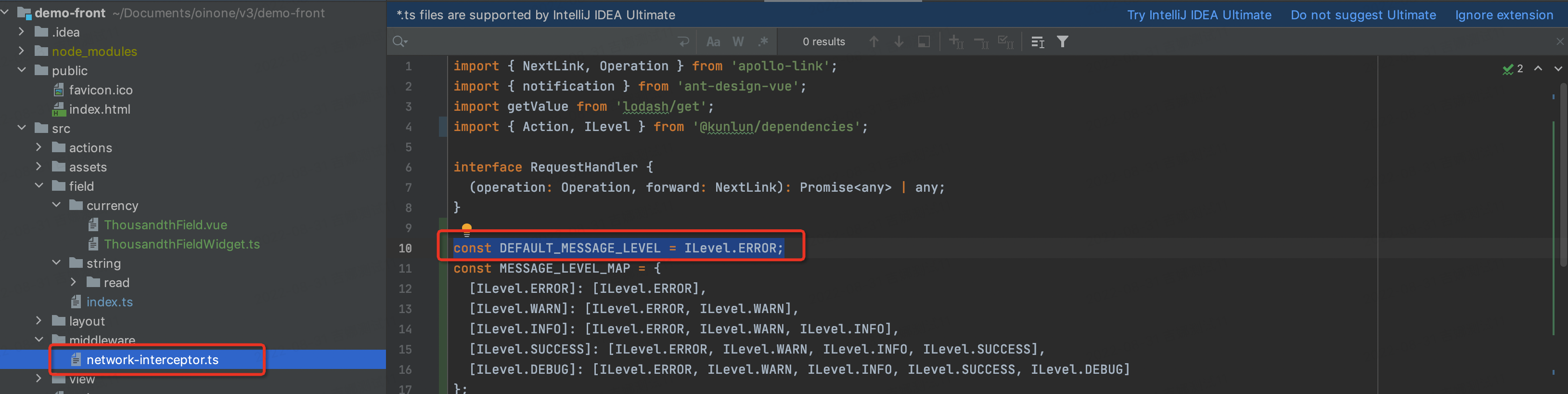
image.png

图4-1-23-2(前端)修改提示级别

const DEFAULT_MESSAGE_LEVEL = ILevel.SUCCESS;

图4-1-23-3(前端)修改提示级别

Step3 重启系统看效果

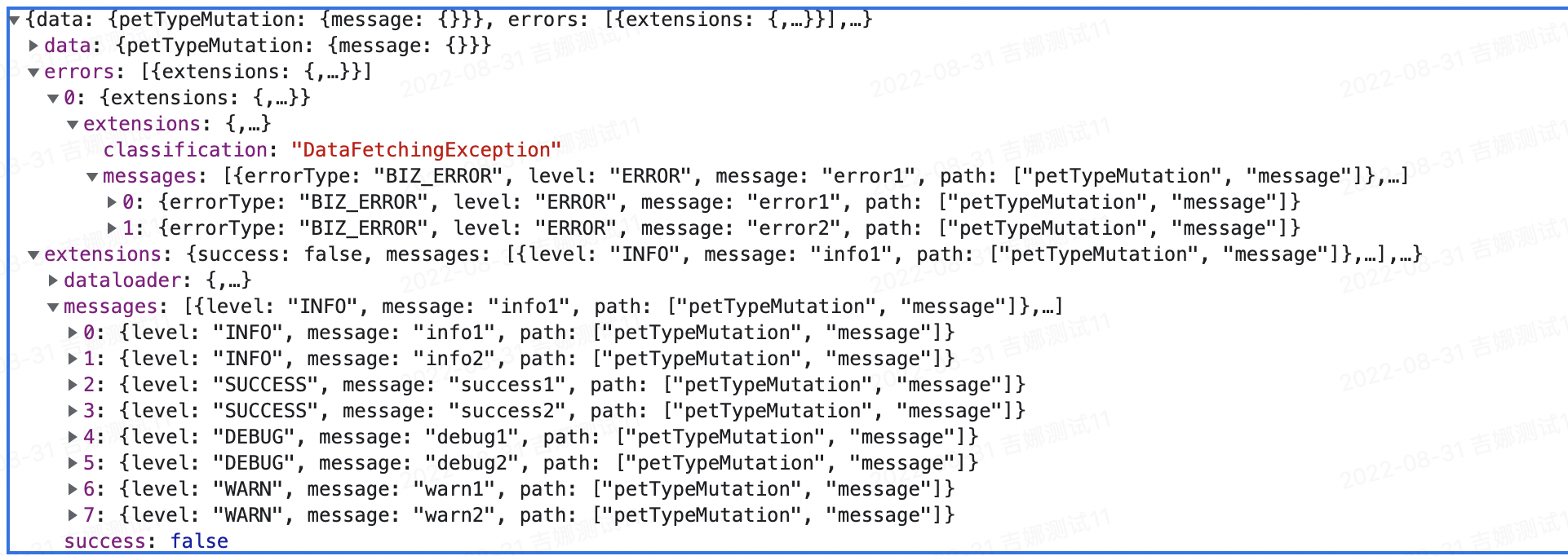
从页面效果中看到已经不在是只提示错误信息。从协议端看错误级别的信息是在errors下,其他级别的信息是在extensions下。
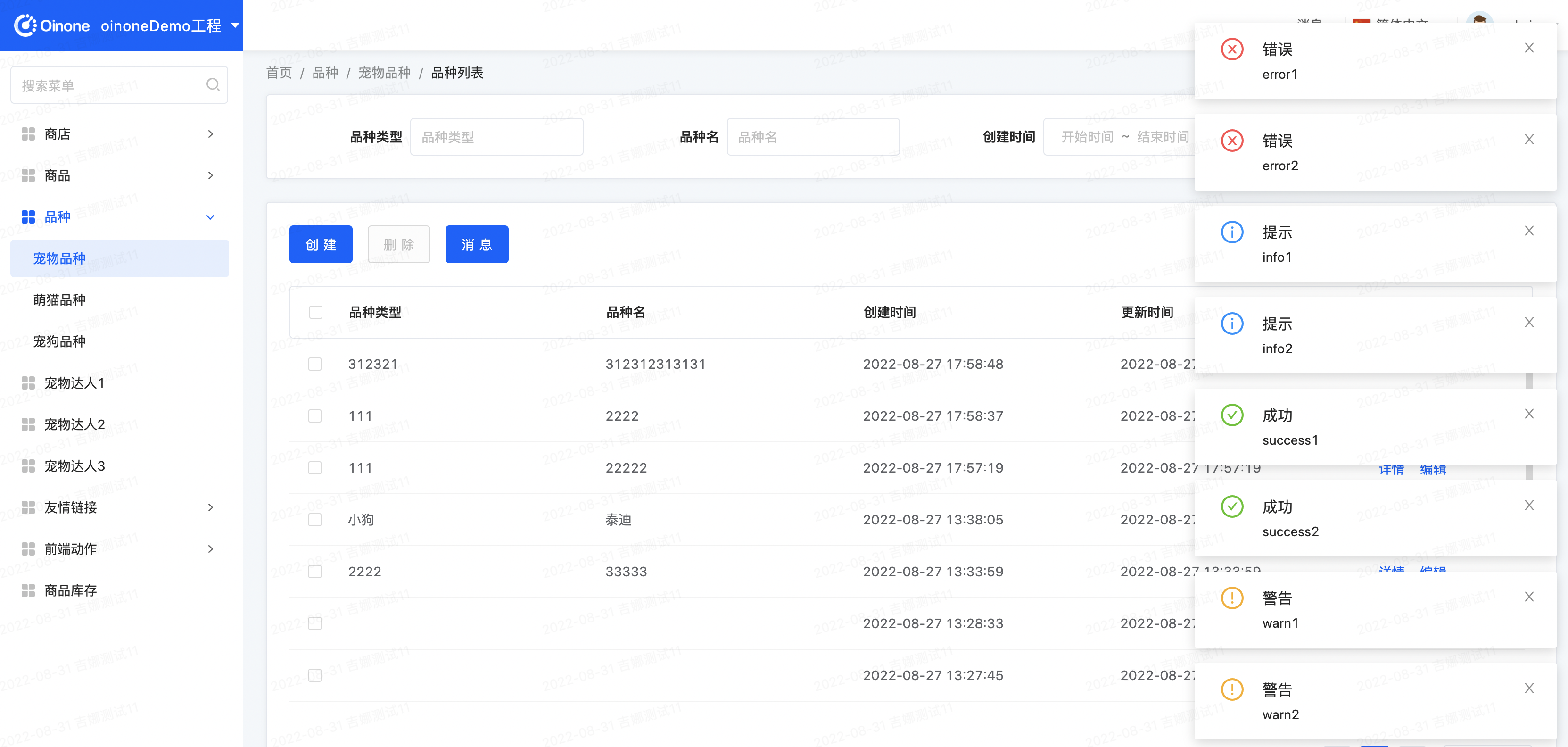
image.png

图4-1-23-4 示例效果

image.png

图4-1-23-5 系统提示的返回结果

二、MessageHub的其他说明

是实现上看MessageHub是基于GQL协议,前后端都有配套实现。同时前端还提供了订阅MessageHub的信息功能,以满足前端更多交互要求,前端MessageHub提供的订阅能力使用教程详见4.2.2前端高级特性之【框架之MessageHub】一文。

Oinone社区 作者:史, 昂原创文章,如若转载,请注明出处:https://doc.oinone.top/oio4/9298.html

访问Oinone官网:https://www.oinone.top获取数式Oinone低代码应用平台体验

(0)
史, 昂的头像史, 昂数式管理员
上一篇 2024年5月23日 am8:40
下一篇 2024年5月23日

相关推荐

  • 翻译

    翻译应用是管理翻译规则的应用,以模型为基础、维护字段的翻译值,支持导入、导出 1. 操作步骤 Step1:导出所有翻译项; Step2:线下翻译; Step3:导入翻译项; Step4:刷新远程资源; Step5:页面右上角可切换语言,查看翻译效果。 2. 新增翻译 翻译是具体到模型字段,其中需要区分出是否字典; 源语言、目标语言,是在资源中维护的语言,可在资源中维护需要翻译的语言; 翻译项则是模型字段,默认翻译项为激活状态,关闭后维护的翻译项无效。 3. 导出、导入 不勾选导出:导出所有需要翻译的翻译项,包括模块、字段,源术语、翻译值等,其中如果已经翻译过的内容,会体现在翻译值中; 勾选导出:导出勾选模型的翻译项。 导入:导入翻译项,平台会根据模型拆分为多条数据。 4. 刷新远程资源 导入翻译项后,点击“刷新远程资源”按钮。 5. 查看翻译内容 页面右上角切换语言,查看翻译效果。

    2024年6月20日
    90300
  • 6.3 数据审计(改)

    在业务应用中我们经常需要为一些核心数据的变更做审计追踪,记录字段的前后变化、操作IP、操作人、操作地址等等。数据审计模块为此提供了支撑和统一管理。它在成熟的企业的核心业务系统中,需求是比较旺盛的。接下来我们开始学习下数据审计模块 准备工作 pamirs-demo-core的pom文件中引入pamirs-data-audit-api包依赖 <dependency> <groupId>pro.shushi.pamirs.core</groupId> <artifactId>pamirs-data-audit-api</artifactId> </dependency> pamirs-demo-boot的pom文件中引入pamirs-data-audit-core和pamirs-third-party-map-core包依赖,数据审计会记录操作人的地址信息,所以也依赖了pamirs-third-party-map-core <dependency> <groupId>pro.shushi.pamirs.core</groupId> <artifactId>pamirs-data-audit-core</artifactId> </dependency> <dependency> <groupId>pro.shushi.pamirs.core.map</groupId> <artifactId>pamirs-third-party-map-core</artifactId> </dependency> pamirs-demo-boot的application-dev.yml文件中增加配置pamirs.boot.modules增加data_audit 和third_party_map,即在启动模块中增加data_audit和third_party_map模块 pamirs: boot: modules: – data_audit – tp_map 为third_party_map模块增加高德接口api,下面e439dda234467b07709f28b57f0a9bd5换成自己的key pamirs: eip: map: gd: key: e439dda234467b07709f28b57f0a9bd5 数据审计 注解式(举例) Step1 新增PetTalentDataAudit数据审计定义类 package pro.shushi.pamirs.demo.core.init.audit; import pro.shushi.pamirs.data.audit.api.annotation.DataAudit; import pro.shushi.pamirs.demo.api.model.PetTalent; @DataAudit( model = PetTalent.MODEL_MODEL,//需要审计的模型 modelName = "宠物达人" ,//模型名称,默认模型对应的displayName //操作名称 optTypes = {PetTalentDataAudit.PETTALENT_CREATE,PetTalentDataAudit.PETTALENT_UDPATE}, fields={"nick","picList.id","picList.url","petShops.id","petShops.shopName"}//需要审计的字段,关系字段用"."连结 ) public class PetTalentDataAudit { public static final String PETTALENT_CREATE ="宠物达人创建"; public static final String PETTALENT_UDPATE ="宠物达人修改"; Step2 修改PetTalentAction的update方法 做审计日志埋点:手工调用 OperationLogBuilder.newInstance().record()方法。需要注意的是这里需要把原有记录的数据值先查出来做对比 @Function.Advanced(type= FunctionTypeEnum.UPDATE) @Function.fun(FunctionConstants.update) @Function(openLevel = {FunctionOpenEnum.API}) public PetTalent update(PetTalent data){ //记录日志 OperationLogBuilder.newInstance(PetTalent.MODEL_MODEL, PetTalentDataAudit.PETTALENT_UDPATE).record(data.queryById().fieldQuery(PetTalent::getPicList).fieldQuery(PetTalent::getPetShops),data); PetTalent existPetTalent = new PetTalent().queryById(data.getId()); if(existPetTalent !=null){ existPetTalent.fieldQuery(PetTalent::getPicList); existPetTalent.fieldQuery(PetTalent::getPetShops); existPetTalent.relationDelete(PetTalent::getPicList); existPetTalent.relationDelete(PetTalent::getPetShops); } data.updateById(); data.fieldSave(PetTalent::getPicList); data.fieldSave(PetTalent::getPetShops); return data; } Step3 重启看效果 修改宠物达人记录对应的字段,然后进入审计模块查看日志

    2024年5月23日
    81600
  • 4.2.4 框架之网络请求-HttpClient

    oinone提供统一的网络请求底座,基于graphql二次封装 一、初始化 import { HttpClient } from '@kunlun/dependencies'; const http = HttpClient.getInstance(); http.setMiddleware() // 必须设置,请求回调。具体查看文章https://shushi.yuque.com/yqitvf/oinone/vwo80g http.setBaseURL() // 必须设置,后端请求的路径 图4-2-4-1 初始化代码示例 二、HttpClient详细介绍 获取实例 import { HttpClient } from '@kunlun/dependencies'; const http = HttpClient.getInstance(); 图4-2-4-2 获取实例 接口地址 import { HttpClient } from '@kunlun/dependencies'; const http = HttpClient.getInstance(); http.setBaseURL('接口地址'); http.getBaseURL(); // 获取接口地址 图4-2-4-3 接口地址 请求头 import { HttpClient } from '@kunlun/dependencies'; const http = HttpClient.getInstance(); http.setHeader({key: value}); 图4-2-4-4 请求头 variables import { HttpClient } from '@kunlun/dependencies'; const http = HttpClient.getInstance(); http.setExtendVariables((moduleName: string) => { return customFuntion(); }); 图4-2-4-5 variables 回调 import { HttpClient } from '@kunlun/dependencies'; const http = HttpClient.getInstance(); http.setMiddleware([middleware]); 图4-2-4-6 回调 业务使用-query private http = HttpClient.getInstance(); private getTestQuery = async () => { const query = `gql str`; const result = await this.http.query('module name', query); console.log(result) return result.data[`xx`]['xx']; // 返回的接口,打印出result对象层次返回 }; 图4-2-4-7 业务使用-query 业务使用-mutate private http = HttpClient.getInstance(); private getTestMutate = async () => { const mutation = `gql str`; const result = await this.http.mutate('module name', mutation); console.log(result) return result.data[`xx`]['xx']; // 返回的接口,打印出result对象层次返回 }; 图4-2-4-8 业务使用-mutate 三、如何使用HttpClient 初始化 在项目目录src/main.ts下初始化httpClient 初始化必须要做的事: 设置服务接口链接 设置接口请求回调 业务实战 前文说到自定义新增宠物表单,让我们在这个基础上加入我们的httpClient; 第一步新增service.ts 图4-2-4-8 新增service.ts service.ts import { HttpClient }…

    2024年5月23日
    1.2K00
  • 工作台

    1. 工作台介绍 工作台用于呈现集成相关的统计数据,包括: 连接器总数:集成资源连接器总数; 数据流程总数:定义的数据连接流程总数; 任务总执行数:任务总执行数(统计流程实例数量); 总异常任务数:总执行异常的任务数; 开放接口数:合计开放接口数量(包含所有状态)。 2. 快捷连接 快捷连接是通过快捷筛选所需要链接的集成资源(应用/Oinone平台应用/数据库等),进入【数据流程创建页】,同时展示平台提供的数据流程模版,点击开始连接可使用数据流程模型创建数据流程。 开始连接后进入流程创建页:

    2024年6月20日
    1.1K00

Leave a Reply

登录后才能评论